

Boost your learning using five cool organizational tools:
Bullet-point Organization for neat, quick lists.
Concept Mapping links ideas to a main theme.
Mnemonic Devices help you remember with fun phrases.
Acronym Usage turns ideas into easy-to-remember words.
Infographic Creation mixes tools to display data clearly.
Try these tools to **increase productivity** and **understanding** a lot.

Turn the school run and nap time into listening time
- Thousands of audiobooks, podcasts and originals
- Listen on your phone, tablet or Echo — also offline
- Cancel anytime
Key Takeaways
- Utilize bullet-point organization for concise information delivery.
- Try concept mapping for visual representation and idea connections.
- Employ mnemonic devices like acronyms for easier recall.
- Harness the power of acronyms to simplify core beliefs.
- Create infographics blending text and visuals for structured information presentation.
bullet point notepad for students
As an affiliate, we earn on qualifying purchases.
As an affiliate, we earn on qualifying purchases.
Bullet-point Organization
To conclude, additionally bullet points serve as a practical tool for listing important information concisely.
By summarizing large processes into key points, they offer a clear and structured overview.
Their simplicity makes them easy to create, aiding in communicating complex ideas in a straightforward manner.
Furthermore, bullet points provide a somewhat-sequential order, guiding readers through the content logically.
This organization method is highly effective for presenting thoughts and ideas in a coherent way, reducing clutter and enhancing the overall readability of documents and presentations.
In essence, utilizing bullet points is a fundamental technique for improving information flow and enhancing organization within various academic, professional, and creative contexts.
Concept Mapping
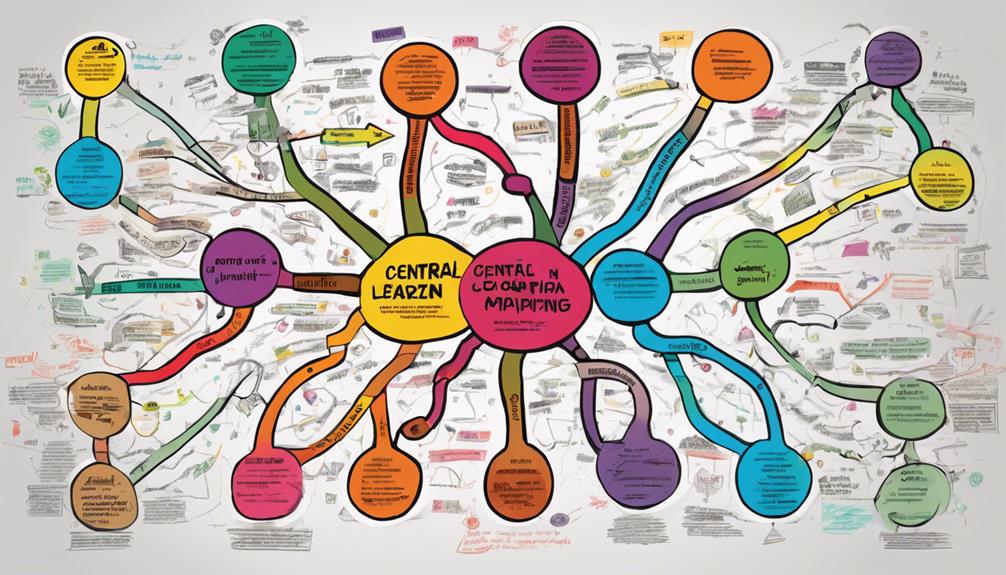
Moving from organizing information in bullet points to a more visually engaging approach, concept mapping provides a highly effective method for representing interconnected ideas and concepts.
These visual representations typically revolve around a central theme, branching out into related subtopics through lines and keywords. Popularized by Tony Buzan as Mind Maps, concept maps incorporate images, symbols, and colors for enhanced visual stimulation and grouping.
By linking concepts together visually, learners can grasp complex relationships more easily and remember information more effectively. Unlike bullet-point lists, concept maps offer a more holistic view of a subject, encouraging a deeper understanding of how ideas connect and interact.
This visual approach can be a powerful tool for organizing thoughts, brainstorming, and studying various topics.
Mnemonic Devices
Utilizing mnemonic devices can greatly enhance memory retention and recall in various learning contexts. Mnemonics are fun phrases that aid in remembering sequences, hierarchies, or concepts. They offer a creative way to solidify information in the mind and make it easier to recall when needed.
Some examples of mnemonic devices include acronyms like 'HOMES' to remember the Great Lakes (Huron, Ontario, Michigan, Erie, Superior) or 'ROY G. BIV' to recall the colors of the rainbow (Red, Orange, Yellow, Green, Blue, Indigo, Violet).
Acronym Usage
Acronyms serve as valuable tools for reinforcing core beliefs and aiding in the efficient recall of lists or categories. They utilize letters to represent concepts, distinct from mnemonics. Examples like MR FAB and MRS GREN demonstrate how acronyms can help remember information effectively. By condensing a list or set of ideas into a memorable word or phrase, acronyms simplify the recall process. This table illustrates the power of acronyms in organizing information:
| Acronym | Concept Represented |
|---|---|
| MR FAB | Movement, Respiration, Sensitivity, Feeding, Adaptation, and Reproduction |
| MRS GREN | Movement, Respiration, Sensitivity, Growth, Reproduction, Excretion, and Nutrition |
| PEMDAS | Parentheses, Exponents, Multiplication, Division, Addition, Subtraction |
| SCUBA | Self-contained underwater breathing apparatus |
| SMART | Specific, Measurable, Achievable, Relevant, Time-bound |
Infographic Creation

Creating infographics involves combining various organizational tools, such as bullet-points, concept maps, mnemonics, and acronyms, to present complex information in a detailed and visually appealing manner.
Infographics are detailed, organized posters that can effectively convey large amounts of information in a visually stimulating way. They offer a blend of text, images, and graphics to enhance comprehension and retention.
Tools like picktochart provide platforms for creating infographics with ease. These visual aids are useful for presenting intricate data sets, processes, or concepts in a structured format.
Frequently Asked Questions
How Can I Apply These Tools to Different Learning Styles?
Understanding different learning styles allows for tailored application of tools like bullet-points, concept maps, mnemonics, acronyms, and infographics. By recognizing visual, auditory, kinesthetic learners, one can choose the most suitable organizational tool to enhance comprehension and retention.
Are There Any Online Platforms for Creating Infographics Easily?
Yes, online platforms like Canva offer easy-to-use tools for creating infographics. These platforms provide templates, graphics, and customization options to help users design visually appealing and informative infographics quickly and efficiently.
Can These Tools Be Used for Studying Languages Effectively?
These tools are highly effective for studying languages. Bullet-points summarize grammar rules, concept maps visualize vocabulary connections, mnemonics aid in memorizing new words, acronyms reinforce language structures, and infographics present language nuances thoroughly.
Are There Any Tips for Combining Multiple Organizational Tools?
Guaranteeing multiple organizational tools involves aligning structures to enhance comprehension. Prioritize clarity and coherence when merging bullet-points, concept maps, mnemonics, acronyms, and infographics. Maintain consistency in style, color, and format for effective integration.
How Can These Tools Be Used in a Professional Work Setting?
In a professional work setting, the utilization of bullet-points, concept maps, mnemonics, acronyms, and infographics can enhance communication, streamline processes, and facilitate understanding. These tools aid in conveying complex information effectively and fostering productivity.
Conclusion
To sum up, incorporating creative organizational tools such as concept maps, mnemonics, acronyms, and infographics can greatly enhance the learning experience by simplifying complex information and promoting active engagement.
These tools serve as the scaffolding of knowledge, guiding individuals through the intricate web of ideas like a skilled navigator leading a ship through rough waters.
By utilizing these strategies, one can navigate the seas of education with confidence and efficiency.
Fall Picks
fall essentials
As an affiliate, we earn on qualifying purchases.