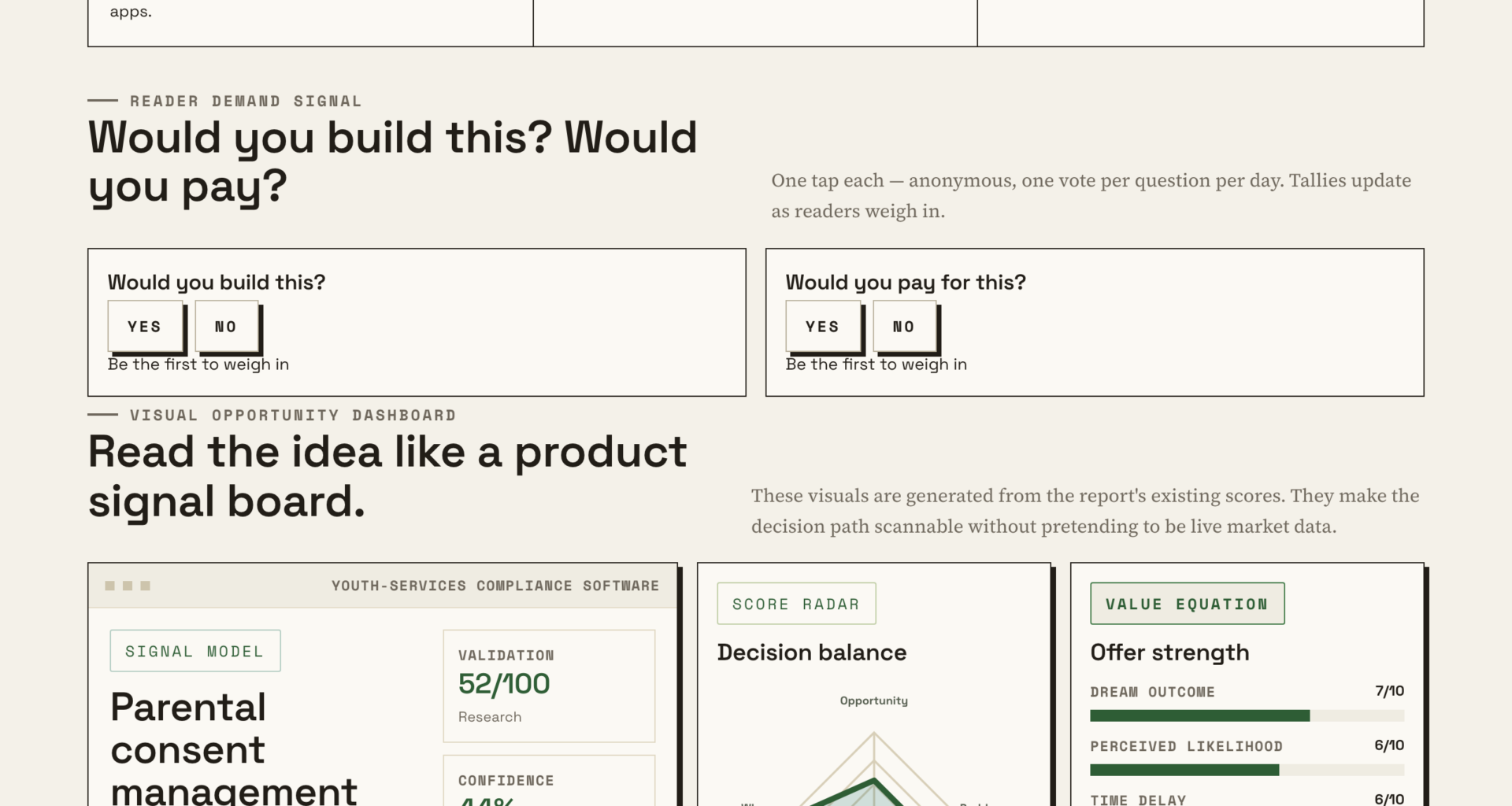

📊 Full opportunity report: Privacy And Parental Consent: A Guide For Youth-Service Vendors on IdeaNavigator AI — validation score, market gap, and execution plan.

Turn the school run and nap time into listening time
- Thousands of audiobooks, podcasts and originals
- Listen on your phone, tablet or Echo — also offline
- Cancel anytime
TL;DR
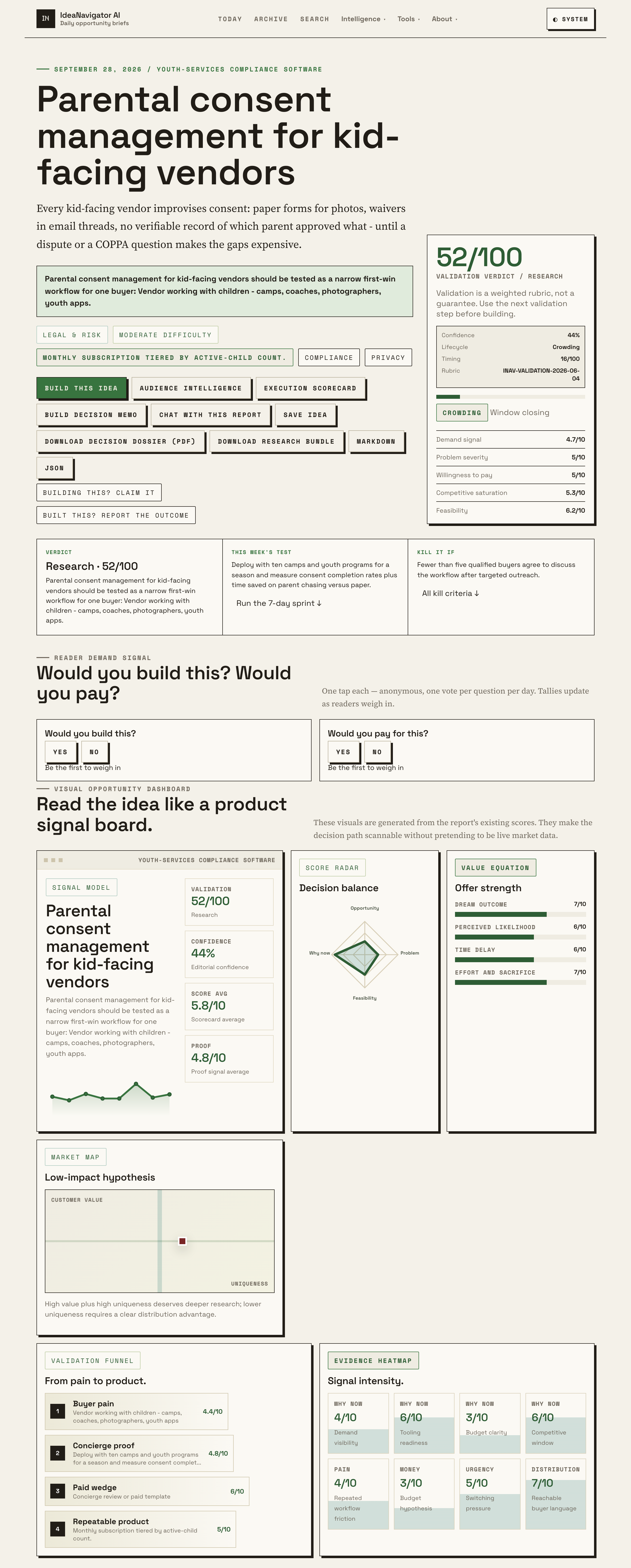
IdeaNavigator AI has outlined a proposed consent-management service for camps and other businesses working with children. The concept would organize parent approvals and records, but there is no reported pilot, customer evidence or confirmed launch; its proposed test is a season with ten youth programs.
IdeaNavigator AI’s proposal says youth-serving vendors often collect consent through separate processes, such as paper forms for photographs and waivers in email threads. It argues that these records may not clearly show which parent approved which use, and that gaps can become costly when disputes or questions about children’s privacy compliance arise. The proposal does not document specific disputes or enforcement actions involving the vendors it describes.
The proposed minimum product would let vendors send branded forms for parents to complete on a phone, according to IdeaNavigator AI. The suggested forms would cover photo use, data collection, medical information and liability. The proposal also describes organizing records by child, tracking expirations and providing audit-record exports, with identity checks matched to perceived risk. It does not specify how identity would be verified, what data would be stored or how long records would be retained.
IdeaNavigator AI proposes a monthly subscription based on the number of active children. To test whether vendors would use and pay for the service, the proposal suggests a season-long deployment with ten camps and youth programs. It would measure consent completion and staff time spent following up with parents against paper processes. The proposal names no participating programs, subscription prices, results or season dates.
A Recordkeeping Problem for Youth Vendors
If the proposed workflow addresses a real operational need, consistent consent records could make approvals easier to track for small organizations that handle children’s photos or information. A record tied to each child could help staff check what permission was given and whether it has expired, while an export could make the organization’s documentation easier to review.
The concept’s practical value depends on details that are not yet established. Vendors and families would need clear choices about what they approve, and a digital log would need to accurately capture those choices. The proposal offers no evidence yet that a shared platform would reduce follow-up work, improve completion rates or satisfy a particular legal requirement. Those questions matter to buyers deciding whether another subscription would simplify their processes or add a new layer of administration.
Top picks for "privacy parental consent"
As an affiliate, we earn on qualifying purchases.
From Paper Forms to a Pilot
IdeaNavigator AI frames the opportunity within youth-services compliance software, naming camps, coaches, photographers and youth apps as possible customers. These businesses and organizations may request different kinds of permission, from image use to data collection, but the proposal does not establish that they share the same consent needs or legal obligations.
The proposal cites changing children’s privacy rules, including COPPA updates and state laws, as reasons vendors may seek clearer records. It also says parents are increasingly challenging how children’s photos and data are used. These points are presented as the proposal’s rationale; it does not cite particular laws, enforcement cases or survey data to quantify the trend. Its proposed first step is a test of one workflow with ten programs for a season, measuring completion rates and staff time saved.
Demand and Compliance Still Unverified
IdeaNavigator AI reports no pilot findings or customer commitments. It remains unclear whether camps and other youth vendors would adopt a single tool across different consent types, how many parents would complete mobile forms, or whether the proposed records would cut staff follow-up time. The suggested ten-program trial is a validation plan, not evidence that the product has been built or tested.
The proposal also leaves open how the service would handle identity checks, data security, record retention, consent withdrawal and differences among applicable rules. It does not identify the specific legal requirements the product would support. Until those points and customer demand are tested, the idea’s likely cost, compliance role and commercial viability remain unknown.
A Ten-Program Seasonal Test
IdeaNavigator AI’s proposal identifies a season-long deployment with ten camps and youth programs as a possible next step. The proposed measures are consent completion rates and staff time spent chasing parents compared with paper-based collection. The proposal reports no start date, recruited participants or results, so it is not clear whether the trial is underway or when findings might be available.
If a pilot proceeds, reporting its methods and results would give vendors information to assess the workflow, its cost and how it handles different kinds of permission. The proposal describes an early product concept; it reports no confirmed launch or evidence that the service meets compliance requirements.
Key Questions
Has the consent-management service launched?
No launch is reported. IdeaNavigator AI describes a proposed product and a possible pilot with ten youth programs.
Who is the proposed service for?
The proposal names camps, coaches, photographers and youth apps as potential customers that work with children.
What would the product do?
It would let parents complete vendor-branded consent forms by phone and give vendors records organized by child, expiry tracking and audit exports. The proposed forms cover photo use, data collection, medical information and liability.
Has the idea been shown to save time or improve consent rates?
No results are provided. The proposal identifies completion rates and staff time spent following up as measures for a future seasonal pilot.
Source: IdeaNavigator AI
Fall Picks
fall essentials
As an affiliate, we earn on qualifying purchases.