The best remote control cars for kids balance easy controls, durable construction, and play features that suit a child’s age and surroundings. My best overall pick is the HAIBOXING 18859 for its all-terrain focus, while the Threeking Flip Stunt Car suits kids who want tricks and the Dafotil Amphibious Truck is a stronger match for wet or mixed terrain. The main tradeoffs are speed versus control, stunt features versus straightforward driving, and rechargeable play time versus battery upkeep. A fast truck can be exciting but harder for a young beginner to manage, while a stunt car may be less suited to ordinary racing. Continue reading for the full breakdown and help matching a car to your child.

Turn the school run and nap time into listening time
- Thousands of audiobooks, podcasts and originals
- Listen on your phone, tablet or Echo — also offline
- Cancel anytime
Complete the kit


Key Takeaways
- All-terrain driving and stunts are different priorities: the HAIBOXING 18859 is the clearest fit for varied ground, while the Threeking and other flip cars put tricks ahead of conventional driving.
- Amphibious models answer a specific play need: the Dafotil, Threeking 1:16 Amphibious Truck, and Lvcdzr suit buyers who want water-friendly play, but their feature set is less relevant for children who mainly drive indoors.
- Speed can work against beginner control: the BLUEJAY’s stated 33 km/h and Kolegend’s 25 km/h make them speed-focused choices, not automatic first cars for younger drivers.
- Modular rechargeable batteries are a practical differentiator: the Zalneo Z1 and QUNREDA Q1 advertise USB-C modular batteries, while other picks may suit families who value stunt variety, lights, or a simpler driving focus more.
- Play style separates the novelty picks from the driving picks: the TIKAFONY transforming car and BEZGAR dinosaur truck lean into visual play, while the Tmuidig race car is the more conventional choice for kids drawn to racing.
| Threeking RC Flip Stunt Car for Kids Ages 6+ |  | Best for Stunt Beginners | Brand: Threeking | Model: RC Stunt Car (TK-R-ST-2-GN) | Recommended age: 6–12 years | VIEW LATEST PRICE | See Our Full Breakdown |
| Zalneo Z1 4WD RC Stunt Car with 360° Flips, LED Light Bar, and USB-C Modular Batteries |  | Best for Easy Battery Swaps | Brand and model: Zalneo Z1 | Recommended age: 6–13 years | Drive: 4WD, dual motor | VIEW LATEST PRICE | See Our Full Breakdown |
| Dafotil 1:18 Amphibious 4WD Remote Control Monster Truck |  | Best for Water and Varied Terrain | Brand and model: Dafotil KT912A | Scale: 1:18 | Recommended age: 6–10 years | VIEW LATEST PRICE | See Our Full Breakdown |
| TIKAFONY Transforming Spider RC Car with Lights |  | Best for Car-to-Robot Play | Brand and model: TIKAFONY KV-004 | Recommended age: 36 months–12 years | Material: ABS plastic | VIEW LATEST PRICE | See Our Full Breakdown |
| HAIBOXING 18859 1:18 Scale 4WD All-Terrain RC Truck |  | Best for Speed and Range | Brand and model: HAIBOXING 18859 | Scale: 1:18 | Recommended age: 8 years and up | VIEW LATEST PRICE | See Our Full Breakdown |
| Kolegend 1:12 RC Monster Truck with LED Lights, 25 km/h, and Two Rechargeable Batteries |  | Best for Longer Outdoor Sessions | Scale: 1:12 | Top speed: Up to 25 km/h | Control frequency: 2.4 GHz | VIEW LATEST PRICE | See Our Full Breakdown |
| BEZGAR 1:20 Remote-Controlled Dinosaur Monster Truck with Lights and Music |  | Best Themed Pick for Stunts | Scale: 1:20 | Dimensions: 7.09 × 5.91 × 7.68 inches | Control frequency: 2.4 GHz | VIEW LATEST PRICE | See Our Full Breakdown |
| OFDO 4WD Stunt RC Car with 360° Flip and RGB Lights |  | Best for Beginners and Extended Play | Age range: 6–12 years | Drive: 4WD | Stunts: More than 9, including 360° flips and double-sided driving | VIEW LATEST PRICE | See Our Full Breakdown |
| Tmuidig 1:16 Scale RC Race Car with LED Lights |  | Best for Multi-Car Racing | Scale: 1:16 | Top speed: Up to 25 km/h | Control frequency: 2.4 GHz | VIEW LATEST PRICE | See Our Full Breakdown |
| Threeking 1:16 Amphibious Monster Truck Remote Control Car |  | Best for Water and Wet-Terrain Play | Scale: 1:16 | Water resistance: IPX6 vehicle body | Control range: Up to 160 feet | VIEW LATEST PRICE | See Our Full Breakdown |
| Lvcdzr Amphibious Remote Control Car, 2.4GHz Waterproof RC Monster Truck |  | Best for Water and All-Terrain Play | Scale: 1:16 | Drive: 4WD | Water resistance: IPX7 | VIEW LATEST PRICE | See Our Full Breakdown |
| BLUEJAY 1:12 Remote Control Monster Truck, 33 km/h |  | Best for Speed | Scale: 1:12 | Maximum speed: 33 km/h | Control frequency: 2.4 GHz | VIEW LATEST PRICE | See Our Full Breakdown |
| QUNREDA Q1 4WD RC Stunt Car with LED Lights and USB-C Modular Batteries |  | Best for Younger Stunt Drivers | Drive: 4WD | Control frequency: 2.4 GHz | Control range: Up to 50 meters | VIEW LATEST PRICE | See Our Full Breakdown |
| QDOJC 4WD RC Stunt Car with Gesture Sensing Wristband and 2.4GHz Remote |  | Best for Gesture-Based Control | Drive: 4WD | Control types: 2.4GHz remote and gesture-sensing wristband | Stunts: 360° stunts, drifts, and upright driving | VIEW LATEST PRICE | See Our Full Breakdown |
| FDCTR M01 Stunt RC Car with 2.4 GHz Remote, RGB Lights, and Two USB-C Rechargeable Batteries |  | Best for Double-Sided Driving and Light Effects | Model: M01 | Material: ABS | Remote frequency: 2.4 GHz | VIEW LATEST PRICE | See Our Full Breakdown |
| remote control cars for kid | Recommended age | Batteries | Control range | Scale |
|---|---|---|---|---|
| Threeking RC Flip Stunt Car fo | 6–12 years | Two 3.7V 600mAh rechargeable batteries | Up to 160 feet | — |
| Zalneo Z1 4WD RC Stunt Car wit | 6–13 years | Two 500mAh USB-C rechargeable modular packs | Up to 165 feet (50 m) | — |
| Dafotil 1:18 Amphibious 4WD Re | 6–10 years | Two 3.7V 1200mAh rechargeable batteries | — | 1:18 |
| TIKAFONY Transforming Spider R | 36 months–12 years | Two rechargeable batteries included | — | — |
| HAIBOXING 18859 1:18 Scale 4WD | 8 years and up | Two 7.4V Li-Po packs | Up to 280 feet | 1:18 |
| Kolegend 1:12 RC Monster Truck | 8–12 years | Two 7.4 V 1000 mAh rechargeable batteries | 50 meters | 1:12 |
| BEZGAR 1:20 Remote-Controlled | 8+ years | — | Up to 115 feet | 1:20 |
| OFDO 4WD Stunt RC Car with 360 | — | Two modular 3.7 V 600 mAh rechargeable batteries | — | — |
| Tmuidig 1:16 Scale RC Race Car | 3 years and up | — | — | 1:16 |
| Threeking 1:16 Amphibious Mons | — | — | Up to 160 feet | 1:16 |
| Lvcdzr Amphibious Remote Contr | 8 years and up | — | — | 1:16 |
| BLUEJAY 1:12 Remote Control Mo | 8–18 years | — | 50 meters | 1:12 |
| QUNREDA Q1 4WD RC Stunt Car wi | 6 years and up | Two rechargeable 500 mAh, 3.7 V modular batteries | Up to 50 meters | — |
| QDOJC 4WD RC Stunt Car with Ge | 6–12 years | — | — | — |
| FDCTR M01 Stunt RC Car with 2. | 6–12 years | Two rechargeable 3.7 V, 600 mAh modular batteries | — | — |
More Details on Our Top Picks
Threeking RC Flip Stunt Car for Kids Ages 6+
The Threeking is a strong first pick for kids who want flips and spins without needing to master the controls right away. Its auto-demo mode performs stunts on its own, while the double-sided body can keep moving after an upside-down landing. Two quick-swap batteries provide up to 55 minutes of combined play, a little more stated runtime than the Zalneo Z1’s 50 minutes. The tradeoff is where it can drive: this model is best on indoor floors and flat outdoor surfaces, not rough ground. Its 160-foot control range is also shorter than the HAIBOXING 18859’s stated 280 feet. I’d choose it for easy stunt play rather than speed or terrain coverage; families wanting an all-terrain truck should look at the HAIBOXING instead.
Pros:- Auto-demo mode gives beginners an easy way to see stunts without precise steering.
- Two rechargeable batteries provide up to 55 minutes of stated combined playtime.
- Double-sided driving and 360-degree flips help it recover from overturned landings.
- Anti-interference technology supports simultaneous play with multiple cars.
Cons:- Not designed for rough terrain or uneven outdoor surfaces.
- Battery charging and maintenance require adult supervision.
- Its 160-foot stated range is shorter than the HAIBOXING 18859’s 280 feet.
Best for: Kids ages 6–12 who are new to stunt cars and want automatic demos plus swappable batteries for longer play sessions.
Not ideal for: Families looking for a vehicle for rough lawns, gravel, or other uneven terrain; this car is intended for indoor and flat outdoor surfaces.
- Brand:Threeking
- Model:RC Stunt Car (TK-R-ST-2-GN)
- Recommended age:6–12 years
- Drive and stunt features:4WD, double-sided driving, 360-degree flips, auto-demo
- Batteries:Two 3.7V 600mAh rechargeable batteries
- Stated playtime:Up to 55 minutes total
- Control range:Up to 160 feet
- Material:ABS plastic
Our verdict“Choose the Threeking for beginner-friendly flips and a long combined play session, but pick an all-terrain truck for rougher ground.”
Zalneo Z1 4WD RC Stunt Car with 360° Flips, LED Light Bar, and USB-C Modular Batteries
The Zalneo Z1 makes stunt play easy to restart: its tool-free modular batteries swap without screws, so a depleted pack does not require opening the car. Kids can flip, spin, and drive upside down, and the demo mode offers a less demanding entry point than steering every stunt manually. Its deep-tread tires are described for carpet, hardwood, lawn, and sand, giving it a broader surface brief than the Threeking stunt car, which is limited to flat ground. Each battery is rated for up to 25 minutes, for 50 minutes combined, but charging takes about 1.5 hours per pack. The controller also needs two AA batteries. Compared with the Threeking, the Z1 trades a little stated total runtime for easier battery changes and a longer stated control range.
Pros:- Modular batteries swap without screws or tools.
- Double-sided driving helps the car continue after upside-down landings.
- Deep-tread tires are specified for carpet, hardwood, lawn, and sand.
- Includes the controller’s two AA batteries and a USB-C charging cable.
Cons:- Each rechargeable battery takes about 1.5 hours to charge.
- The controller requires two AA batteries.
- Its stated combined runtime is five minutes less than the Threeking’s.
Best for: Families who want a stunt car for several indoor and outdoor surfaces and prefer battery swaps that do not need tools.
Not ideal for: Buyers who want minimal charging downtime or a controller that runs solely on included rechargeable packs; each car battery takes about 1.5 hours to charge and the remote needs AA batteries.
- Brand and model:Zalneo Z1
- Recommended age:6–13 years
- Drive:4WD, dual motor
- Stunt features:360-degree flips, spins, double-sided driving, demo mode
- Batteries:Two 500mAh USB-C rechargeable modular packs
- Stated runtime:Up to 25 minutes per battery; 50 minutes combined
- Charging time:About 1.5 hours per battery
- Control range:Up to 165 feet (50 m)
- Dimensions:6.3 x 6.3 x 2.9 inches
Our verdict“Pick the Z1 if easy, tool-free battery swaps and varied-surface stunt play matter more than the Threeking’s slightly longer stated combined runtime.”
Dafotil 1:18 Amphibious 4WD Remote Control Monster Truck
The Dafotil is the clearest choice here for kids who want to take their RC play beyond dry floors: its sealed electronics and waterproof design are intended for water use, while 4WD and shock-absorbing, grippy tires support varied terrain. That gives it a different job from the Zalneo Z1, whose appeal is stunt tricks rather than amphibious driving. Dafotil includes two 1200mAh batteries and states up to 60 minutes of play per battery, though charging each takes two to three hours. Its roughly 100-foot operating distance is modest beside the HAIBOXING 18859’s stated 280 feet. Beach outings also call for rinsing after seawater exposure, so it is not a maintenance-free water toy. I’d favor it for kids who will actually use the water capability, not families seeking the quickest charging setup.
Pros:- Waterproof design and sealed electronics support use on water.
- 4WD, grippy tires, and shock absorption suit varied terrain.
- Includes two 1200mAh rechargeable batteries.
- Removable body shell gives access to the truck’s interior.
Cons:- Each battery takes about two to three hours to charge.
- The roughly 100-foot stated operating distance is shorter than the HAIBOXING 18859’s.
- The truck should be rinsed after use in seawater or at the beach.
Best for: Kids ages 6–10 who want one 4WD truck for water play and varied terrain, with a spare battery ready for a second session.
Not ideal for: Families who mainly want a long-range racer or a low-maintenance beach toy; the stated range is about 100 feet, and seawater use calls for rinsing afterward.
- Brand and model:Dafotil KT912A
- Scale:1:18
- Recommended age:6–10 years
- Drive:4WD
- Batteries:Two 3.7V 1200mAh rechargeable batteries
- Stated playtime:Up to 60 minutes per battery
- Charging time:2–3 hours
- Operating distance:Roughly 100 feet
- Features:Waterproof design, LED lights, 360-degree rotation, removable shell
Our verdict“Choose the Dafotil for water-friendly, varied-terrain play, but go with the HAIBOXING if longer control range matters more than amphibious use.”
TIKAFONY Transforming Spider RC Car with Lights
The TIKAFONY stands apart from the truck and flip-car picks by changing the play pattern: one button transforms it from a sports car into a robot, and demo mode adds movement without requiring constant steering. Red and blue LEDs in the eyes and underbody emphasize the character-toy angle, while 2.4GHz control supports multiple cars playing at once. Compared with the Zalneo Z1, this model offers a more imaginative transformation, but not the same clearly specified range of stunt tricks or terrain use. The biggest buying question is battery information: two rechargeable batteries are included, yet the product data gives no runtime or charging time. That makes it harder to plan longer play sessions than with the Threeking, which states up to 55 minutes total. I’d choose this for kids who value transforming action over measurable driving performance.
Pros:- One-button transformation switches between sports car and robot modes.
- Automatic demo mode offers a simple way to start play.
- Red and blue LEDs light the eyes and underbody.
- 2.4GHz control supports simultaneous play with multiple cars.
Cons:- Battery runtime and charging time are not specified.
- The product data does not give a control range or detailed terrain guidance.
- Its appeal centers on transformation rather than the defined flips and double-sided driving of the Zalneo Z1.
Best for: Kids drawn to robots and character toys who want a remote-controlled car that changes form at the push of a button.
Not ideal for: Parents comparing playtime or charging needs, or kids seeking a clearly specified all-terrain truck; runtime and charging details are not provided.
- Brand and model:TIKAFONY KV-004
- Recommended age:36 months–12 years
- Material:ABS plastic
- Control frequency:2.4GHz
- Transforming modes:Sports car and robot
- Movement:360-degree rotations
- Lighting:Red and blue eye and underbody LEDs
- Batteries:Two rechargeable batteries included
Our verdict“Pick the TIKAFONY for a child who wants a transforming robot-car toy, not for a buyer prioritizing documented runtime or terrain performance.”
HAIBOXING 18859 1:18 Scale 4WD All-Terrain RC Truck
The HAIBOXING 18859 is the performance-oriented pick in this group: its 36 KPH top speed, proportional controls, and stated 280-foot range give older kids more room to steer and cover ground than the Dafotil, whose range is roughly 100 feet. Independent suspension, ball bearings, and a solid gear differential support its all-terrain focus on short grass, gravel, and concrete. Two 7.4V Li-Po batteries provide up to 40 minutes of stated runtime, less than the Threeking’s 55-minute combined figure, so this truck favors pace and control distance over longer listed playtime. Its electronics are splash-waterproof, not submersible; the Dafotil is the better fit for water play. I’d choose the HAIBOXING for kids ready for a faster, more capable driving experience, with an adult available to help match the charger to the specified power source.
Pros:- Reaches a stated top speed of up to 36 KPH.
- Independent suspension, ball bearings, and a solid gear differential support all-terrain driving.
- Stated control range of up to 280 feet exceeds the other trucks in this batch.
- Includes two rechargeable 7.4V Li-Po battery packs.
Cons:- Up to 40 minutes of stated runtime is less than the Threeking’s 55-minute combined figure.
- Splash-waterproof electronics are not suitable for full submersion.
- Charging requires a compatible 5V, 2A USB power source.
Best for: Kids ages 8 and up who want a faster 4WD truck for short grass, gravel, and concrete, plus a longer stated control range.
Not ideal for: Younger children seeking a stunt-focused toy or families wanting full submersion capability; this truck is splash-waterproof only and is recommended for ages 8+.
- Brand and model:HAIBOXING 18859
- Scale:1:18
- Recommended age:8 years and up
- Drive:4WD
- Top speed:Up to 36 KPH
- Control range:Up to 280 feet
- Batteries:Two 7.4V Li-Po packs
- Stated runtime:Up to 40 minutes
- Water resistance:Splash-waterproof electronics
Our verdict“Choose the HAIBOXING for an older child who values speed, range, and rougher-ground driving over stunt tricks or water use.”
Kolegend 1:12 RC Monster Truck with LED Lights, 25 km/h, and Two Rechargeable Batteries
For kids who want a larger truck for outdoor driving, the Kolegend K-301 pairs a 1:12 scale body with a stated top speed of 25 km/h. Its two rechargeable batteries are the main advantage over the BEZGAR dinosaur truck, whose listed playtime is shorter and varies between 20 and 25 minutes. Kolegend claims up to 50 minutes of play, so swapping batteries can keep a session going without waiting for a recharge. Suspension and stated suitability for grass, sand, and concrete add flexibility, while the headlights and chassis lights make the truck more visible in dim conditions. The tradeoff is its plastic construction, which may be less reassuring for repeated hard impacts than a sturdier-feeling choice. Its 8–12 age guidance also makes it a less obvious pick for younger beginners.
Pros:- Two 7.4 V rechargeable batteries support up to 50+ minutes of stated playtime.
- Suspension and stated use on sand, grass, and concrete suit varied outdoor routes.
- 2.4 GHz control and a stated 50-meter range support driving with other compatible vehicles.
- Headlights and chassis LEDs add visibility and a more engaging look in dim conditions.
Cons:- Plastic construction may be a concern for kids who frequently drive into obstacles.
- The recommended age range is 8–12, making it less clearly suited to younger children.
- Its larger 1:12 scale may be less convenient to store and carry than smaller options.
Best for: Ages 8–12 who want a larger outdoor truck and value having a second rechargeable battery ready for longer play sessions.
Not ideal for: Younger children or buyers prioritizing a vehicle designed for water play; this truck is plastic and has no stated waterproof rating.
- Scale:1:12
- Top speed:Up to 25 km/h
- Control frequency:2.4 GHz
- Control range:50 meters
- Batteries:Two 7.4 V 1000 mAh rechargeable batteries
- Stated playtime:Up to 50+ minutes
- Lighting:LED chassis lights and headlights
- Recommended age:8–12 years
Our verdict“Choose the Kolegend for an older child who wants a roomy outdoor truck and more playtime from two included batteries.”
BEZGAR 1:20 Remote-Controlled Dinosaur Monster Truck with Lights and Music
The BEZGAR dinosaur truck makes its case through personality and quick tricks rather than long sessions or a large footprint. Its dinosaur styling, driving sounds, three LED modes, and ability to perform spins, wheelies, and drifts give kids several ways to play beyond steering forward and back. Compared with the Tmuidig race car, which focuses on speed and racing, this BEZGAR is better suited to short, showy runs and playful stunts. Its 2.4 GHz control also supports multi-truck play, with a stated range of up to 115 feet. The compromise is runtime: product details list 20–25 minutes, so the exact expectation is unclear and it falls short of the Kolegend’s stated battery life. It is also recommended for ages 8 and up.
Pros:- Performs 360° spins, wheelies, and drifting for varied stunt play.
- Dinosaur styling, driving sounds, and three lighting modes add character.
- 2.4 GHz control supports play with multiple compatible trucks.
- Includes a lithium-ion battery and has a stated range of up to 115 feet.
Cons:- Listed playtime is inconsistent at 20–25 minutes.
- Recommended for ages 8 and up, limiting its fit for younger children.
- Plastic construction may be less suited to frequent rough impacts.
Best for: Kids aged 8 and older who prefer dinosaur styling, sound and light effects, and stunt moves over longer continuous driving.
Not ideal for: Families seeking a longer-running RC car or a speed-focused racer; listed playtime varies, and the feature set centers on stunts and effects.
- Scale:1:20
- Dimensions:7.09 × 5.91 × 7.68 inches
- Control frequency:2.4 GHz
- Control range:Up to 115 feet
- Stated playtime:20–25 minutes; product details vary
- Battery:One included lithium-ion battery
- Lighting:Steady, fast flash, and slow pulse modes
- Features:360° spins, wheelies, drifting, lights, and music
- Recommended age:8+ years
Our verdict“Pick the BEZGAR for an older child who will value themed stunt play more than extended runtime or straightforward racing.”
OFDO 4WD Stunt RC Car with 360° Flip and RGB Lights
The OFDO is the most beginner-friendly stunt choice here, with a one-button demo mode that gives a new driver a way to see the car’s tricks before learning the controls. Double-sided driving and more than nine listed stunts, including 360° flips, give it a different kind of play from the Tmuidig race car, which is built around speed and racing rather than tricks. Its strongest practical advantage is the pair of modular batteries: the stated total of up to 84 minutes is far beyond the BEZGAR’s listed 20–25 minutes, though actual runtime depends on conditions. USB-C charging is convenient, but the remote needs two AA batteries, which are included. The car is described for concrete, sand, and grass, yet the stated maximum runtime depends on smooth surfaces, so rough terrain may reduce that advantage.
Pros:- Two modular batteries provide up to 84 minutes of stated total playtime.
- One-button demo mode offers an approachable introduction to stunt functions.
- USB-C charging uses a common cable type, and the included batteries are modular.
- Double-sided driving and multiple stunts keep play varied after basic steering.
Cons:- The remote requires two AA batteries, adding a separate power requirement.
- The maximum stated runtime depends on smooth surface conditions.
- Its stunt-focused design may not suit children who mainly want a traditional racing car.
Best for: Children aged 6–12 who are new to RC stunts and families who want swappable batteries and USB-C charging.
Not ideal for: Buyers looking for a conventional fast race car or all-terrain performance with a guaranteed runtime; its playtime depends on surface conditions.
- Age range:6–12 years
- Drive:4WD
- Stunts:More than 9, including 360° flips and double-sided driving
- Batteries:Two modular 3.7 V 600 mAh rechargeable batteries
- Stated playtime:42 minutes per battery; up to 84 minutes total
- Charging interface:USB-C
- Charge time:About 1.5 hours
- Controller frequency:2.4 GHz
- Included remote power:Two AA batteries
Our verdict“Choose the OFDO for a young stunt-car beginner who wants simple controls and long play sessions from two swappable batteries.”
Tmuidig 1:16 Scale RC Race Car with LED Lights
For a child who wants to race rather than flip or crawl over rough ground, the Tmuidig Race Car S1 offers a clear alternative to the BEZGAR’s stunt-heavy approach. Its stated 25 km/h top speed, supercar shape, and front and rear LEDs make it a better match for straight runs and informal races. The 2.4 GHz remote is listed as supporting multiple cars at once without signal interference, which gives siblings or friends a reason to bring their own vehicles. It is listed for use on surfaces including carpets and outdoor tracks, though it does not have the Kolegend’s stated suspension and sand-and-grass emphasis. Expect about 30 minutes per charge, and note that the remote needs two AAA batteries that are not included. The age guidance says 3 years and up, but adult judgment is still sensible for a fast-moving toy.
Pros:- Stated top speed of 25 km/h suits children who want a fast race-car feel.
- 2.4 GHz control supports racing multiple cars without signal interference.
- Front and rear LEDs make the car visible in low-light play.
- Listed for use on carpets and outdoor tracks.
Cons:- The remote requires two AAA batteries, which are not included.
- Approximate 30-minute battery life means sessions require recharging.
- Its race-car format is less suited to stunt play or rough off-road routes than the BEZGAR or Kolegend.
Best for: Families with children who want to race multiple compatible RC cars on carpet or outdoor tracks.
Not ideal for: Buyers who want included remote batteries, extended runtime, or a truck designed specifically for rough terrain and suspension travel.
- Scale:1:16
- Top speed:Up to 25 km/h
- Control frequency:2.4 GHz
- Battery life:Approximately 30 minutes
- Charging time:Approximately 2 hours
- Lighting:Front and rear LED lights
- Recommended age:3 years and up
- Remote power:Two AAA batteries, not included
Our verdict“Pick the Tmuidig for a child who wants fast, multi-car races rather than off-road driving or stunt tricks.”
Threeking 1:16 Amphibious Monster Truck Remote Control Car
The Threeking stands apart from the other picks by bringing IPX6 waterproofing into the mix, making it the clearest choice for kids who want to drive on land and in water. That sets it apart from the Kolegend, whose description names sand, grass, and concrete but does not state water protection. Shock-resistant anti-collision beams and high-grip tires add support for bumpy routes, while the remote can control races with up to six trucks and has a stated 160-foot range. There is a practical catch: the remote itself is not waterproof, and the battery compartment must be sealed carefully. After seawater exposure, the truck needs a fresh-water rinse. That care makes it less carefree than the OFDO stunt car, but a better fit for families planning water-edge play. Adult supervision is called for during battery installation.
Pros:- IPX6 waterproof vehicle body supports land and water use.
- Anti-collision beams are designed to absorb impacts.
- High-grip tires suit varied terrain.
- 2.4 GHz multi-player support allows up to six trucks to race, with a stated 160-foot range.
Cons:- The remote controller is not waterproof.
- Seawater exposure calls for rinsing the vehicle with fresh water.
- Battery installation and compartment sealing require adult supervision and care.
Best for: Families with children aged 6–12 who want an RC truck for land routes and water play and are willing to handle post-use care.
Not ideal for: Buyers seeking a low-maintenance toy for unsupervised water play; the remote is not waterproof, and the battery compartment needs careful sealing.
- Scale:1:16
- Water resistance:IPX6 vehicle body
- Control range:Up to 160 feet
- Multi-player support:Up to 6 trucks
- Age range:6–12 years
- Power source:Battery powered
- Included components:Battery, charging cable, product manual, and remote
- Model number:TK3086B
Our verdict“Choose the Threeking for supervised land-and-water play if you are comfortable sealing the battery compartment and rinsing the truck after use.”
Lvcdzr Amphibious Remote Control Car, 2.4GHz Waterproof RC Monster Truck
For kids who want to drive from the yard into a shallow pool or through wet conditions, the Lvcdzr’s IPX7 waterproof design sets it apart from the BLUEJAY 1:12 Monster Truck, which is intended for outdoor driving but has no stated amphibious capability. Its 4WD setup, shock-absorbing suspension, and ABS construction suit uneven ground, while two included batteries provide a stated total of more than 60 minutes of play. The 2.4GHz system also supports multiple cars, though the maker advises powering them on in sequence to avoid initial signal conflicts. The tradeoff is its more specialized use: at a recommended age of 8 years and up, it may not suit younger children, and its water-ready design matters less to families who mainly drive indoors. I’d choose it for outdoor variety, not for maximum speed.
Pros:- IPX7 waterproof design allows amphibious use in water and wet conditions.
- 4WD and shock-absorbing suspension are suited to varied outdoor surfaces.
- Two included rechargeable batteries provide over 60 minutes of stated play time.
- 2.4GHz control supports multiple cars racing together.
Cons:- Multiple units may need to be powered on sequentially to avoid initial signal conflicts.
- The stated 8+ age recommendation excludes many younger kids.
- The product data does not provide a control range or maximum speed for comparison.
Best for: Families with children aged 8 and up who want one RC truck for wet conditions, shallow-water play, and rough outdoor terrain.
Not ideal for: Families looking for an indoor-first car, or younger children who fall below the stated 8+ age recommendation.
- Scale:1:16
- Drive:4WD
- Water resistance:IPX7
- Control frequency:2.4GHz
- Battery count:2 included
- Stated play time:Over 60 minutes
- Material:ABS
- Recommended age:8 years and up
Our verdict“Pick the Lvcdzr for an older child who will make regular use of its water-ready design and outdoor 4WD capability.”
BLUEJAY 1:12 Remote Control Monster Truck, 33 km/h
The BLUEJAY is the speed-focused choice in this group: its 33 km/h maximum speed and 1:12 scale give it a more substantial, fast-driving feel than the smaller stunt cars, such as the QUNREDA Q1. A stated 50-meter control range gives kids room to drive outdoors, and the two 7.4 V batteries add up to as much as 70 minutes of run time. Each battery is listed for about 35 minutes, so play still involves charging or swapping between sessions. The aluminum alloy body and ABS chassis are described as impact resistant, but this truck is designed primarily for outdoor use, not tight indoor spaces or trick-focused play. I’d favor it over the Lvcdzr for speed on dry ground; the Lvcdzr is the better fit when water play is the draw.
Pros:- Maximum speed is stated as 33 km/h.
- Two 7.4 V rechargeable batteries provide up to 70 minutes of combined run time.
- Stated remote range is 50 meters.
- Aluminum alloy body and ABS chassis are described as impact resistant.
Cons:- Each battery is listed for about 35 minutes, so longer play depends on swapping or recharging.
- Designed primarily for outdoor use and may be difficult to enjoy in confined indoor spaces.
- Its speed-focused design does not offer the stunt tricks of the QUNREDA Q1.
Best for: Families with children aged 8 and up who have outdoor space and want a fast truck with a stated control range and two rechargeable batteries.
Not ideal for: Buyers who need an indoor car, water-ready design, or stunt features such as flips and spins.
- Scale:1:12
- Maximum speed:33 km/h
- Control frequency:2.4 GHz
- Control range:50 meters
- Battery:7.4 V, 1400 mAh rechargeable
- Batteries included:2
- Stated total run time:Up to 70 minutes
- Recommended age:8–18 years
Our verdict“Choose the BLUEJAY for an older child who wants fast outdoor driving rather than stunts or water play.”
QUNREDA Q1 4WD RC Stunt Car with LED Lights and USB-C Modular Batteries
The QUNREDA Q1 is the most straightforward stunt pick here for a younger child: its two-button control triggers nine tricks, including 360° flips and spins, and the recommended age starts at 6 years. That makes it a more age-accessible alternative to the Lvcdzr and BLUEJAY trucks, both listed for ages 8 and up. Two modular batteries provide up to 50 minutes of combined play, and USB-C charging plus tool-free battery swaps make it easier to restart play than a setup that requires more involved battery changes. The tradeoff is that each battery is listed for up to 25 minutes, and the remote still needs two AA batteries. Its 50-meter range is ample for many play areas, but this is a trick car rather than a speed-focused outdoor truck.
Pros:- Two-button controller activates nine stunts, including 360° flips and spins.
- Two modular batteries offer up to 50 minutes of combined play.
- USB-C charging and tool-free battery swaps simplify battery changes.
- Recommended for ages 6 and up, younger than the Lvcdzr and BLUEJAY age ranges.
Cons:- Each battery is listed for up to 25 minutes of play.
- The remote requires two AA batteries.
- Control range is listed at up to 50 meters.
Best for: Families with children aged 6 and up who want easy-to-trigger tricks, quick battery swaps, and a car for indoor or outdoor play.
Not ideal for: Buyers seeking high top speed, a longer stated range, or a truck built around water and rough-terrain driving.
- Drive:4WD
- Control frequency:2.4 GHz
- Control range:Up to 50 meters
- Stunts:Nine, including 360° flips and spins
- Batteries:Two rechargeable 500 mAh, 3.7 V modular batteries
- Stated play time:Up to 25 minutes per battery; up to 50 minutes with both
- Charging:USB-C
- Recommended age:6 years and up
Our verdict“Choose the QUNREDA Q1 for a younger child who values simple stunt controls over truck speed or amphibious driving.”
QDOJC 4WD RC Stunt Car with Gesture Sensing Wristband and 2.4GHz Remote
The QDOJC gives kids a choice between a conventional remote and a gesture-sensing wristband, making it the most hands-on control option in this batch. That distinction matters for children who enjoy directing movement with their gestures; the QUNREDA Q1 instead keeps stunt operation on a simpler two-button controller. The QDOJC is described as capable of 360° spins, drifts, and upright driving, with shockproof tires intended for indoor and outdoor surfaces. Two rechargeable batteries help extend a play session, though the listed runtime is up to 25 minutes per battery, so the spare is useful rather than incidental. The supplied information does not state a control range or charging connector, which makes it harder to compare on those points. Its 6–12 age range also makes it less suited to older hobbyists.
Pros:- Includes both a 2.4GHz remote and a gesture-sensing wristband.
- Stunt features include 360° spins, drifts, and upright driving.
- Two rechargeable batteries allow a swap between play sessions.
- Shockproof tires are intended for indoor and outdoor surfaces.
Cons:- Each battery is listed for up to 25 minutes of use.
- The supplied product data does not state a control range or charging connector.
- The recommended 6–12 age range may limit its appeal to older drivers.
Best for: Children aged 6–12 who want to experiment with gesture steering as well as a standard remote and stunt driving.
Not ideal for: Older hobbyists or buyers who prioritize a specified control range, charging details, or longer uninterrupted sessions.
- Drive:4WD
- Control types:2.4GHz remote and gesture-sensing wristband
- Stunts:360° stunts, drifts, and upright driving
- Battery life:Up to 25 minutes per battery
- Rechargeable batteries included:2
- Tires:Shockproof, wear-resistant
- Recommended age:6–12 years
- Included control accessory:Hand gesture controller wristband
Our verdict“Pick the QDOJC if gesture control is a major part of the fun; choose the QUNREDA Q1 for more clearly specified range and charging details.”
FDCTR M01 Stunt RC Car with 2.4 GHz Remote, RGB Lights, and Two USB-C Rechargeable Batteries
The FDCTR M01 is a strong match for kids who want a stunt car that keeps moving after it flips: its double-sided driving supports flips and spins without requiring the car to be turned upright by hand. It is listed for hardwood, carpet, grass, and gravel, giving it a broader stated surface mix than the QUNREDA Q1’s general all-terrain tire description. Color-changing RGB lights across the headlights and wheels add a visual focus that differs from the QDOJC’s gesture-control novelty. Two modular batteries are included, each with up to 30 minutes of stated play, and USB-C charging makes the swap routine simple. The remote still needs two AA batteries, and this is a stunt-focused car, not a substitute for the BLUEJAY’s higher-speed outdoor truck.
Pros:- Double-sided driving lets the car continue after flips.
- Designed for hardwood, carpet, grass, and gravel.
- Two modular rechargeable batteries provide up to 30 minutes each.
- USB-C charging and color-changing RGB headlights and wheel lights add convenience and visibility.
Cons:- The remote requires two AA batteries.
- The stated runtime is up to 30 minutes per battery, not a single uninterrupted session.
- Its stunt design is less suited to buyers looking for the BLUEJAY’s speed-focused outdoor driving.
Best for: Children aged 6–12 who want a flip-capable car for mixed household and yard surfaces, with bright lighting and swappable batteries.
Not ideal for: Buyers seeking a high-speed truck, gesture controls, or a remote that does not need separate AA batteries.
- Model:M01
- Material:ABS
- Remote frequency:2.4 GHz
- Remote range:Up to 50 meters
- Batteries:Two rechargeable 3.7 V, 600 mAh modular batteries
- Stated play time:Up to 30 minutes per battery
- Charging:USB-C
- Recommended age:6–12 years
Our verdict“Choose the FDCTR M01 for a child who wants a resilient flip-and-spin car with lighting and easy battery swaps across several surfaces.”
How We Picked
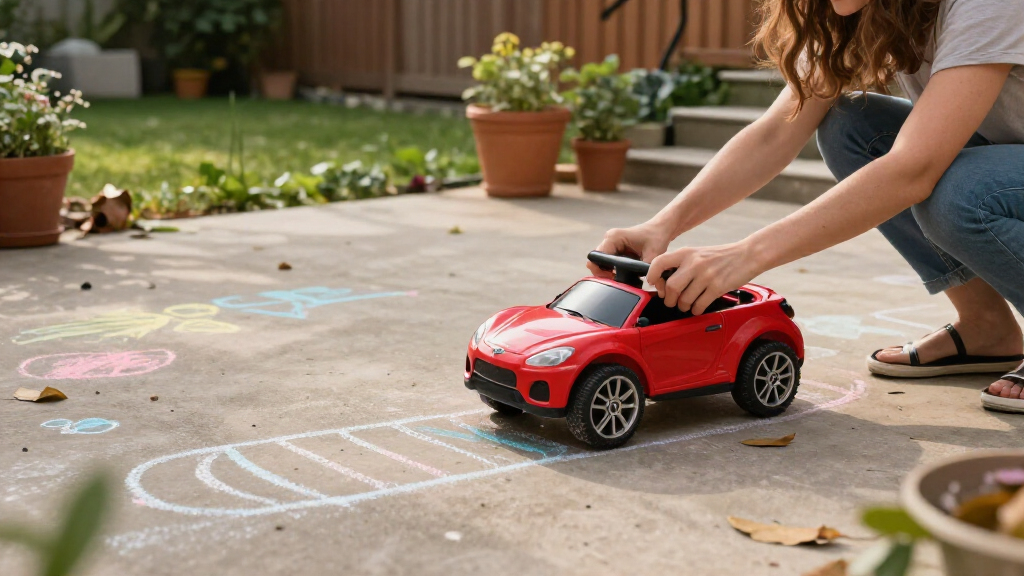
I ranked these cars around the needs that matter most when a child is at the controls: manageable driving, durability for ordinary bumps, and a clear match to the child’s play style. I also weighed whether the advertised features offer practical value, such as all-terrain capability, amphibious use, stunt movement, lighting, or rechargeable batteries. Age suitability, control type, battery arrangements, and the likely space needed to play all affect how useful a car will be after the initial novelty wears off.
The order reflects how broadly useful each model appears for kids, not which one has the longest feature list. A versatile truck ranks ahead of a specialist stunt or novelty car for families seeking one main vehicle; dedicated water, stunt, speed, and imaginative-play models rank higher for children with those specific interests. Claims such as speed, waterproofing, or terrain ability should be checked against the manufacturer’s instructions and the intended play environment, since a feature label alone does not tell a parent how easy a car will be to control.
Factors to Consider When Choosing Best Remote Control Cars For Kids
Choosing well starts with the child and the place the car will be driven, not the biggest speed figure or the most lights. These factors help narrow the options before comparing individual models.
Match the Controls to the Child’s Experience
A child who is new to RC driving may get more enjoyment from predictable steering and a manageable pace than from advanced tricks. A stunt car can be fun, but its unusual movements may take practice and can make ordinary steering feel less intuitive. Check the recommended age, controller layout, and whether the child can operate the controls without help. For a first car, prioritize a clear control scheme over extra modes. Older or experienced kids may be ready for faster models, but open space and adult supervision still matter.
Choose for the Surface, Not the Marketing Label
Wheels and body shape affect where a car can be driven comfortably. A monster truck or all-terrain design is a better starting point for uneven outdoor ground than a low-profile race car, which is generally more at home on smoother surfaces. Amphibious models may broaden play options, but waterproof claims do not mean a car can be used in every body of water or left wet after play. Read the care instructions before driving through water, mud, or sand. A common mistake is buying for an imagined adventure spot when most driving will actually happen in a hallway or driveway.
Treat Speed as a Control and Space Question
Higher stated speed can make a car feel more exciting, but it also calls for more room and quicker reactions. Before choosing a fast model, think about nearby furniture, people, pets, and whether the child has a suitable outdoor area. A lower-speed or stunt-focused car may be a better fit for small spaces, even if its headline speed is less impressive. Parents should also check whether the model offers a way to limit speed; do not assume that it does. Speed matters most when the child can use it safely, not simply because it is the largest number in a listing.
Plan Around Batteries and Play Sessions
Battery setup affects how often play has to pause and how much adult help a child needs. A second rechargeable battery can help keep a session going while the other battery charges, but it also means keeping track of another component. USB-C modular batteries may make swapping more convenient, though charging time and actual run time still depend on the product and how it is driven. Check what comes in the box, how charging works, and whether replacement batteries are available. Do not treat a rechargeable label as a guarantee of long sessions or quick charging.
Pick Features That Fit the Child’s Kind of Fun
Stunts, lights, music, transformation, gesture control, and racing each appeal to different kinds of play. A child who loves performing tricks may prefer a flip car, while a child who invents stories may spend more time with a transforming or themed vehicle. Extra controls can add novelty, but they may also introduce more steps and make the car harder to operate. Ask whether the child mainly wants to drive, compete, perform tricks, or play imaginative games. Paying for features that match that preference is more sensible than choosing the longest feature list.
Check Durability, Care, and Replacement Needs
Kids’ cars may encounter collisions, grit, and rough surfaces, so the body and wheels matter as much as the feature set. No RC car should be treated as indestructible, and a flashy design does not guarantee sturdy construction. Look for clear care instructions, accessible charging, and information about replacement parts or batteries before buying. Water and dirt can add cleaning and drying work even when a model is built for those conditions. If the car will be shared among siblings, a simpler design may be easier to maintain than a model with more specialized moving parts.
Frequently Asked Questions
Which type of RC car is the easiest for a child to learn on?
For a beginner, start with a straightforward controller and a car intended for the child’s age rather than choosing by speed or feature count. A conventional truck or race car can make basic steering easier to understand than a model built around flips, gestures, or transformation. Stunt features can still suit a beginner who is specifically excited by tricks, but expect a learning period. Give the child open space and a short practice session before driving near furniture or other people. Adult guidance is useful until the child can steer and stop reliably.
Is an amphibious RC car a good choice if my child will mostly drive on land?
It can be, but the amphibious feature adds the most value when water play is a regular part of the plan. If most driving will happen indoors or on dry pavement, a conventional all-terrain or stunt car may be a better use of the budget and easier to care for. Water-friendly does not mean maintenance-free: check the maker’s limits for water depth and conditions, and follow drying and cleaning instructions after use. Avoid assuming that a car can safely handle pools, streams, or salt water unless its documentation specifically allows those settings. Choose an amphibious model for a real play need, not just the appeal of the label.
Should I choose a faster car or one with stunt features?
Choose based on where the child will drive and what kind of play holds their attention. A faster truck is better suited to open outdoor space and a child who already has some control practice. A stunt car offers tricks and visual variety that can be more engaging in a smaller play area, though it may not behave like a standard racer. Neither type is automatically better for every child, and both still need room away from people and breakable objects. If you are unsure, favor manageable controls and a good play-space match over the largest speed claim.
Do two rechargeable batteries matter more than USB-C charging?
They solve different problems: a second battery can reduce pauses during a play session, while USB-C describes a charging connection and may make charging more convenient. Check whether the batteries are included, how long charging takes, and whether the car can be used with a spare while the other charges. A modular battery may be easier for an adult to swap, but it does not by itself promise longer run time. If the child tends to play in short bursts, a simple charging setup may matter more than carrying a spare. Compare the complete battery arrangement rather than relying on one feature name.
What should I check before letting a child use an RC car outdoors?
First, match the surface to the car and confirm that there is enough open space for its speed and turning behavior. Check the age guidance, controller operation, battery condition, and any care limits for water, dirt, or rough ground. Keep the car away from traffic, steep drops, crowded paths, and places where it could disturb others. Younger children should have adult supervision, especially with faster models or cars used near water. After outdoor play, follow the manufacturer’s cleaning and drying directions so grit or moisture does not cause avoidable wear.
Conclusion
For families who want one versatile starting point, I would choose the HAIBOXING 18859 as the best overall pick for its all-terrain focus. The Threeking RC Flip Stunt Car is my best value-style choice for kids whose priority is tricks, while the BLUEJAY 1:12 is the premium-leaning option for experienced children with room to handle a faster truck. For beginners, I would prioritize a straightforward car like the Tmuidig race car over gesture controls or high speed. Pick the Dafotil Amphibious Truck for water-friendly play, the Zalneo Z1 or QUNREDA Q1 if modular USB-C batteries matter most, and the TIKAFONY or BEZGAR for imaginative, novelty-led play. The best match is the one that suits the child’s experience and the space where it will actually be driven.