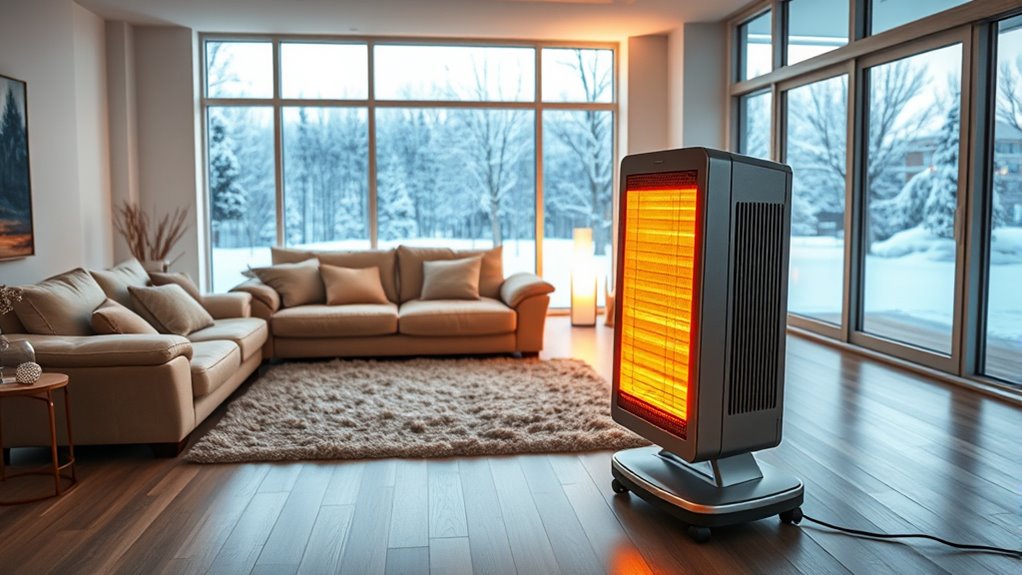

Heating a large room is where most space heaters fall short: a compact ceramic unit that warms a bedroom quickly becomes useless when you point it at an open-concept living area. For this comparison, I focused only on models that can genuinely heat 300+ square feet without running nonstop. The DREO 24” Tower Space Heater earns my best overall pick for its combination of wide oscillation, precise thermostat, and quiet operation at scale. The Dr. Infrared Heater DR-968 stands out as the premium alternative because its infrared design heats objects and people directly rather than just the air, which matters in drafty rooms. On the value side, the Pelonis Oscillating Ceramic Tower covers nearly the same footprint for less. The main tradeoff you’ll face is speed versus depth: ceramic tower heaters warm air fast but lose ground in tall or drafty spaces, while infrared units heat steadily but take longer to feel. Read on for the full breakdown of all ten models.

Turn the school run and nap time into listening time
- Thousands of audiobooks, podcasts and originals
- Listen on your phone, tablet or Echo — also offline
- Cancel anytime
Complete the kit


Key Takeaways
- Tower-style heaters dominated this comparison for large rooms — the DREO 24” and Pelonis tower models moved heat across far more floor area than the compact cube-style DREO units.
- The Dr. Infrared DR-968 was the only heater here that heats objects rather than air, making it the strongest pick for rooms with high ceilings or poor insulation where warm air escapes quickly.
- Four of the ten products were DREO models, and they were not interchangeable: the portable ceramic versions are better for spot heating, while the tower versions are the ones actually suited to large-room duty.
- A readable, adjustable thermostat separated the top picks from the rest — models with just a dial thermostat tended to overshoot and cycle, wasting power in big spaces.
- Remote controls and programmable timers mattered more in this category than in typical heater roundups, because a large-room heater usually sits far from where you sit or sleep.


| space heater for large room | Safety Features | Noise Level | Timer | Power |
|---|---|---|---|---|
| Space Heaters for Indoor Use w | Tip-over protection, overheat auto shut-off | — | — | 1500W |
| DREO Space Heaters for Indoor | Tip-over prevention, overheat protection, auto-off timer | 34dB | — | 1500W |
| DREO Space Heater | Tip-over and overheat protection, child lock, V0 flame-retardant, safety plug | 34dB | 12 hours | 1500 watts |
| DREO 1500W Ceramic Space Heate | Tip-over and overheat protection, V0 flame-retardant materials | 34 dB | 12 hours | — |
| DREO 24” Tower Space Heater f | Child lock, tip-over, overheat, cool-touch housing (8 protections) | 34 dB | 12 hours | — |
| 25-Inch Space Heater for Indoo | Child lock, tip-over protection, overheat protection | — | — | 1500W |
| Pelonis Oscillating Ceramic To | Tip-over and overheat protection | <55 dB | 12 hours | 1500W |
| DREO Heater 319 Quiet 1500W Po | Child lock, tip-over and overheat protection, flame-retardant material, safety plug | As low as 34 dB | 12 hours | — |
| Dr. Infrared Heater DR-968 Por | — | 39 dB | 12-hour automatic shut-off | — |
| DREO 25 Inch Electric Space He | — | As low as 25 dB | — | — |
More Details on Our Top Picks
Space Heaters for Indoor Use with Thermostat, 1500W Electric Heater
Buyers on a budget usually face a tradeoff between adjustable heat output and price, and this model avoids that compromise by offering three wattage stages — 700W, 1000W, and 1500W. Compared with the DREO 1500W Ceramic Heater, which only offers 1000W and 1500W settings, the extra low stage here means gentler background warmth and lower running costs on milder days. The remote control plus thermostat pairing is uncommon at this price, letting you dial in comfort from across the room. The tradeoff is that it lacks the oscillation and ECO energy-saving mode that the DREO models include, so heat distribution is more directional. Safety fundamentals — tip-over and overheat shutoff — are intact, which matters if kids or pets are nearby.
Pros:- Three heat settings for flexible energy use
- Remote control and thermostat at an accessible price
- Tip-over and overheat protection with ETL certification
- Light and easy to move between rooms
Cons:- No oscillation, so coverage is directional
- Remote batteries not included
- No ECO mode for automatic energy savings
Best for: Budget-conscious buyers who want fine control over heat output without paying for premium features
Not ideal for: Anyone heating a wide, open room — no oscillation means heat stays concentrated in one direction
- Power:1500W
- Heat Settings:700W / 1000W / 1500W
- Thermostat:Built-in, with remote control
- Safety Features:Tip-over protection, overheat auto shut-off
- Cord Length:6 ft
- Certification:ETL
Our verdict“A sensible choice for small-to-medium rooms where you want adjustable warmth and basic safety at a lower cost.”
DREO Space Heaters for Indoor Use, Large Electric Heater with Remote
What separates this DREO unit from the 1500W budget model earlier in this lineup is its focus on wide-angle, even coverage — the feature that actually matters in a large room. Instead of blasting one corner, it spreads heat across up to 250 sq. ft., and the 34dB noise floor makes it quiet enough to run beside a bed. The 41°F to 95°F temperature range gives real seasonal flexibility, and V-0 flame-retardant housing plus an auto-off timer round out the safety picture. Compared with the DREO portable model (B0C6FCKQML), it trades a bit of portability and the child lock for broader coverage, which is the right call for a primary room heater rather than a desk companion.
Pros:- Wide-angle heating for even coverage in large rooms
- Near-silent 34dB operation
- Adjustable temperature from 41°F to 95°F
- Auto-off timer and V-0 flame-retardant housing
Cons:- No smart home compatibility
- Coverage tops out at 250 sq. ft. — genuinely vast rooms need more
Best for: Light sleepers and couples who need steady, whole-night warmth in a bedroom or living room without fan noise
Not ideal for: Smart home enthusiasts — there is no app or voice assistant integration
- Power:1500W
- Coverage Area:250 sq. ft.
- Temperature Range:41°F to 95°F
- Noise Level:34dB
- Safety Features:Tip-over prevention, overheat protection, auto-off timer
- Material:V-0 flame-retardant
Our verdict“The pick for anyone whose first requirement is silence in a sizeable bedroom or office.”
DREO Space Heater, Portable Electric Heater with Thermostat, 1500W PTC Ceramic, 34dB Quiet, Remote
At 3 pounds, this is the heater you carry from the home office to the garage to the kids’ room, and that mobility is its whole reason for being. The heat funnel design pushes warmth up to 200% farther than basic ceramic heaters, which partially offsets its modest 200 sq. ft. coverage. Where it beats the DREO tower model is precision and control: 1°F thermostat increments, a 12-hour timer, a child lock, and memory that restores your last settings. The safety plug is a thoughtful extra that reduces outlet-level risks. The honest tradeoff: if your room is genuinely large, the smaller coverage ceiling and compact form mean it works harder and longer than a dedicated tower unit.
Pros:- Truly portable at just 3 pounds
- 1°F precise thermostat with memory function
- Child lock and safety plug for households with kids
- Four speeds plus ECO and fan-only modes
Cons:- Lowest heating coverage of the group at 200 sq. ft.
- Corded only — you’re always tied to an outlet
Best for: People who heat different rooms at different times of day and want precise, set-and-forget temperature control on the move
Not ideal for: Open-concept living areas — 200 sq. ft. coverage is the smallest in this lineup
- Power:1500 watts
- Heating Element:PTC ceramic
- Temperature Range:41–95°F in 1°F increments
- Noise Level:34dB
- Heating Coverage:200 sq. ft.
- Timer:12 hours
- Weight:3 pounds
- Safety Features:Tip-over and overheat protection, child lock, V0 flame-retardant, safety plug
Our verdict“Buy it if flexibility across rooms matters more than raw coverage; skip it for one big space that needs constant heat.”
DREO 1500W Ceramic Space Heater with Thermostat
This model earns its spot by heating 270 sq. ft. — the largest coverage figure among the compact ceramic units here — while adding 70° oscillation to sweep that warmth across the room. Compared with the DREO portable (B0C6FCKQML), you give up the child lock and memory function but gain 70 more square feet of coverage and a slightly taller heat throw. The 24-hour auto shutoff is a standout safety detail none of the other picks match: even if you leave for a weekend and forget it, the heater shuts itself down. ECO mode helps trim electricity use over long evenings. The catch is placement — it must plug directly into a wall outlet, which limits where you can position it in larger rooms.
Pros:- Largest compact-unit coverage at 270 sq. ft.
- 70° oscillation spreads heat evenly
- 24-hour automatic shutoff for unattended safety
- ECO mode trims long-run energy use
Cons:- Must plug directly into a wall outlet
- No 700W low heat setting — only 1000W and 1500W
Best for: Buyers with a large bedroom or living room who prioritize maximum coverage and unattended-use safety
Not ideal for: Rooms where the nearest outlet isn’t where you need heat — no extension cords allowed
- Heating Power:1000W or 1500W
- Heating Type:PTC ceramic
- Heating Coverage:270 sq. ft.
- Noise Level:34 dB
- Oscillation:70°
- Timer:12 hours
- Automatic Shutoff:24 hours without interaction
- Safety Features:Tip-over and overheat protection, V0 flame-retardant materials
Our verdict“The strongest all-around choice for a single large room, provided an outlet sits within 6 feet of where you want it.”
DREO 24” Tower Space Heater for Large Rooms, PTC Ceramic with Thermostat and Remote
This is the pick that best matches the roundup’s actual promise: serious heat for a large room. The combination of dual DC motors and a 25% larger PTC ceramic plate delivers warmth in roughly 2 seconds across 250 sq. ft. — faster than the standard DREO 1500W model, which relies on a single motor. The ECO mode claims up to 40% energy savings, which matters when a heater runs for hours daily, and the tall 24-inch tower form pushes air at seated height rather than ankle level. Eight safety layers — child lock, tip-over, overheat, cool-touch housing — make it the most family-ready option here. The fan-only mode is the weak point, adding little value in summer compared with a real fan.
Pros:- 2-second heat delivery from dual DC motors and oversized ceramic plate
- ECO mode with up to 40% energy savings
- Eight safety protections including child lock and cool-touch housing
- Tall tower design distributes heat at body height
Cons:- Fan-only mode is underpowered for summer use
- Tower footprint takes more floor space than compact units
Best for: Families with children or pets who need fast, safe, efficient heating as a room’s primary heat source
Not ideal for: Anyone hoping the fan mode doubles as summer cooling — it doesn’t move enough air to matter
- Height:24 inches
- Heat Output:1500 watts
- Heating Element:PTC ceramic (25% larger plate)
- Heating Coverage:250 sq. ft.
- Temperature Range:41–95°F
- Noise Level:34 dB
- Oscillation:70°
- Timer:12 hours
- Safety Features:Child lock, tip-over, overheat, cool-touch housing (8 protections)
Our verdict“If one heater has to carry a large family room through winter safely and efficiently, this is the one to buy.”
25-Inch Space Heater for Indoor Use with Thermostat, Oscillating Tower Heater with Remote Control and Timer
For a large room where maintaining a set temperature matters more than fine-tuning heat output, this tower’s AI mode and electronic thermostat give it a distinct role. Its 1500W ceramic PTC element and oscillation are intended to spread warmth across a wider area, while the remote lets you adjust settings from across the room. Compared with the DREO 25 Inch Electric Space Heater, it offers fewer documented heat modes and less precise control detail, but automatic adjustment may suit someone who prefers to set a target and leave it alone. The tradeoff is that AI mode may stop heating once the target temperature is reached, and there are only two heat settings. Room coverage figures and noise levels are not specified, so buyers with a particularly large space or a quiet-bedroom requirement have less information to go on.
Pros:- AI mode adjusts heating around the selected temperature
- Oscillation helps distribute forced-air warmth across the room
- Remote control allows adjustments from a seat or bed
- Tip-over and overheat protection are listed
Cons:- Only two heat settings are specified
- AI mode may stop heating after reaching the target temperature
- No coverage area or noise level is provided
Best for: People heating a large bedroom or living area who want a remote and automatic temperature adjustment
Not ideal for: Buyers who need a stated room coverage range, several heat levels, or published noise information
- Power:1500W
- Voltage:120V
- Heating element:Ceramic PTC
- Heating method:Forced air
- Temperature range:60–95°F
- Heat settings:2
- Form factor:25-inch tower
- Safety features:Child lock, tip-over protection, overheat protection
Our verdict“Choose this tower if automatic temperature adjustment and remote operation matter more to you than detailed coverage data or multiple heat levels.”
Pelonis Oscillating Ceramic Tower Indoor Space Heater, 1500W, with Thermostat, ECO Mode, Timer, Remote Control, Safety Features
The Pelonis is the clearest pick here for shoppers who want a stated coverage figure: it is rated for up to 220 square feet, with 75-degree oscillation to move heat around that footprint. That makes it easier to judge against the DREO Heater 319, which lists coverage up to 200 square feet and puts more emphasis on low noise and fine thermostat adjustments. Pelonis instead pairs its stated coverage with multiple modes, ECO mode, a 12-hour timer, and remote operation. The listed noise level is under 55 dB, so it may be less suited to noise-sensitive sleepers than the DREO models reporting lower levels. It is still a 1500W indoor heater; the coverage figure is a guide, not a promise of even warmth in every room layout or insulation condition.
Pros:- Specified coverage of up to 220 square feet
- 75-degree oscillation helps spread warmth across the room
- 12-hour timer and remote simplify scheduled adjustments
- Multiple modes and thermostat support temperature control
Cons:- Noise level is listed as under 55 dB, higher than the quietest DREO claims in this lineup
- 1500W output may be insufficient for a very large or poorly insulated room
- Specified for indoor use only
Best for: Buyers heating a bedroom or home office around 220 square feet who want stated coverage and timer control
Not ideal for: Light sleepers prioritizing the lowest documented noise, or anyone needing heat for a room substantially larger than the stated coverage
- Power:1500W
- Coverage area:Up to 220 ft²
- Height:23 inches
- Oscillation:75°
- Timer:12 hours
- Noise level:<55 dB
- Heating element:Ceramic
- Safety features:Tip-over and overheat protection
Our verdict“Pick the Pelonis when a stated 220-square-foot coverage figure and timer matter more than especially quiet operation.”
DREO Heater 319 Quiet 1500W Portable Space Heater
At up to 34 dB, the DREO Heater 319 is aimed at buyers who want background warmth without much fan noise. Its stated 200-square-foot coverage makes it a better fit for a large bedroom or office than an expansive open-plan space. Compared with the Pelonis Oscillating Ceramic Tower, it covers a smaller stated area but offers a quieter published noise figure and thermostat adjustments in one-degree increments. The 70-degree oscillation helps share warmth across the room, while five speeds give more adjustment choices than the two settings on the 25-inch heater in this batch. Its 1500W draw and need for an electrical outlet still constrain placement and room size; the 200-square-foot rating is the useful boundary for buyers considering it as a large-room heater.
Pros:- Low published noise level of 34 dB
- Thermostat adjusts in one-degree increments across a broad range
- 70-degree oscillation distributes heat beyond a fixed direction
- Child lock, tip-over, overheat, and safety plug protections are listed
Cons:- Stated coverage tops out at 200 square feet
- Corded electric operation limits placement to areas near an outlet
- 1500W maximum output may not meet the needs of larger or drafty rooms
Best for: Light sleepers and home-office users heating a room up to about 200 square feet
Not ideal for: People trying to heat a large open-plan area beyond its stated 200-square-foot coverage
- Heating power:1500W
- Coverage:Up to 200 ft²
- Heating element:PTC ceramic
- Thermostat range:41–95°F
- Temperature adjustment:1°F increments
- Oscillation:70°
- Noise level:As low as 34 dB
- Timer:12 hours
- Safety features:Child lock, tip-over and overheat protection, flame-retardant material, safety plug
Our verdict“Choose the Heater 319 for quiet warmth and precise control in a bedroom or office near its 200-square-foot coverage limit.”
Dr. Infrared Heater DR-968 Portable Space Heater, 1500-Watt, Cherry
The DR-968 takes a different approach from the oscillating towers: its infrared quartz and PTC dual heating system combines radiant heat with a blower, and the listed output is 5200 BTU. That makes it a substantial supplemental-heating option, though the provided data does not state a room coverage area, which makes it harder to compare directly with the DREO 25 Inch Electric Space Heater and its 100–270-square-foot range. The DR-968 offers high and low power settings, a 12-hour shut-off timer, and a 39 dB noise figure. Its 19-pound weight and six-foot cord make it less convenient to reposition than a small tower, even with caster wheels. Buyers should also account for its 12.5-amp draw when sharing a circuit with other appliances.
Pros:- Dual infrared quartz and PTC heating system
- High and low power settings provide an alternative to full output
- 39 dB noise figure and 12-hour automatic shut-off timer
- Tip-over and overheat protection with no exposed heating elements
Cons:- No room coverage figure is provided
- At 19 pounds, it is heavier to move than a compact tower heater
- 12.5-amp draw may limit use on a circuit shared with other equipment
Best for: Households wanting a portable supplemental heater with radiant and forced-air heat for a room of unspecified size
Not ideal for: Buyers who need a published square-foot coverage rating or frequently carry a heater between floors
- Power settings:1500W high / 1000W low
- Heating capacity:5200 BTU
- Heating system:Infrared quartz tube and PTC
- Thermostat range:50–85°F
- Noise level:39 dB
- Timer:12-hour automatic shut-off
- Weight:19 lb
- Power cord:72 inches
- Certification:UL Listed for USA and Canada
Our verdict“Consider the DR-968 for supplemental heat and dual heating methods if its missing coverage rating and heavier cabinet fit your room and setup.”
DREO 25 Inch Electric Space Heater for Indoor Use, Large Room, Thermostat
This DREO tower earns the leading large-room spot on the strength of its 100–270-square-foot coverage range, 70-degree oscillation, and several operating modes. Compared with the Pelonis Oscillating Ceramic Tower, it claims a wider maximum coverage area and adds three heat levels plus ECO and fan modes, giving buyers more ways to adapt it through changing conditions. Its 25 dB noise claim and thermostat that adjusts from 41–95°F in one-degree increments also make it a strong fit for bedrooms and offices. The tradeoff is a corded 1500W design that limits placement, and the listing reports 16A, so buyers should check their circuit requirements. As with other portable electric heaters, its coverage figure does not guarantee even heating in every large or drafty room.
Pros:- Stated coverage reaches up to 270 square feet
- Four heat modes plus fan-only mode offer varied operation
- Low published noise level of 25 dB and precise thermostat adjustments
- Child lock, tip-over and overheat protections, flame-retardant material, and ETL certification are listed
Cons:- Corded operation restricts where it can be placed
- Coverage tops out at 270 square feet, limiting suitability for very large open spaces
- Listed 16A draw may require buyers to check circuit compatibility
Best for: Buyers seeking a quiet, adjustable tower heater for a bedroom, office, or living room within its stated 100–270-square-foot range
Not ideal for: People heating spaces larger than 270 square feet, or those who need cordless placement flexibility
- Height:25 inches
- Heat output:1500W
- Heating coverage:100–270 ft²
- Thermostat range:41–95°F
- Heating modes:H1, H2, H3, ECO, and fan mode
- Oscillation:70°
- Noise level:As low as 25 dB
- Voltage and amperage:120V, 16A
- Safety:Overheat and 45° tip-over protection, child lock, V0 flame-retardant material, ETL certified
Our verdict“Choose this DREO tower for quiet, flexible heating across a room within its stated 100–270-square-foot range.”

How We Picked
I judged every heater against one question: can it raise and hold the temperature of a 300–500 square foot room without running constantly? That filtered the field immediately. Compact ceramic heaters were evaluated on how far their heat actually carries, while towers were judged on oscillation range and airflow volume. I then compared thermostat quality, because a cheap thermostat in a big room means endless on-off cycling, and safety features like tip-over protection and overheat shutoff, which are non-negotiable for a high-wattage unit running for hours.
From there, I weighted usability factors — remote access, timer functions, noise at full output — and build quality, since large-room heaters work harder and longer than desk units. Value was assessed relative to coverage: a cheaper heater that only warms half the room scores worse than a pricier one that does the whole job. That logic drives the ranking: the DREO 24” tower earns best overall for balancing all of these, while infrared and portable picks earn their spots for specific room conditions rather than all-around performance.
| space heater for large room | Heating Element |
|---|---|
| Space Heaters for Indoor Use w | — |
| DREO Space Heaters for Indoor | — |
| DREO Space Heater | PTC ceramic |
| DREO 1500W Ceramic Space Heate | — |
| DREO 24” Tower Space Heater f | PTC ceramic (25% larger plate) |
| 25-Inch Space Heater for Indoo | Ceramic PTC |
| Pelonis Oscillating Ceramic To | Ceramic |
| DREO Heater 319 Quiet 1500W Po | PTC ceramic |
| Dr. Infrared Heater DR-968 Por | — |
| DREO 25 Inch Electric Space He | — |
Factors to Consider When Choosing Space Heater For Large Room
Before picking a specific model, it helps to understand what actually determines whether a heater can handle a large room — and where buyers most often go wrong.Wattage Is Capped, So Design Matters More
Nearly every household space heater in this roundup maxes out at 1500 watts, because that’s the safe limit of a standard 120-volt outlet. What that means practically: no heater on this list is fundamentally “more powerful” than another. The difference is how effectively each one distributes that 1500 watts. A tall oscillating tower spreads heat across a wide arc, while a small directional unit concentrates it in one spot. If a heater’s marketing implies massive power advantages, treat that with skepticism — coverage comes from airflow and design, not wattage. This is also why I ranked the tower and infrared models above compact ceramic cubes for this use case.
Match the Heater Type to Your Room’s Weakness
Large rooms fail to stay warm for different reasons, and the right heater depends on which one applies to you. Ceramic fan heaters are fastest at raising air temperature, ideal for closed rooms with normal ceilings. Infrared heaters like the Dr. Infrared DR-968 work differently: they warm people, floors, and furniture directly, which pays off in drafty rooms or spaces with high ceilings where heated air rises away from you. A common mistake is buying a fast ceramic heater for a loft or open-plan area, then wondering why the warmth vanishes. If your room leaks heat, depth of heating beats speed.
Thermostat Quality Determines Your Power Bill
In a large room, the thermostat is arguably the most important component, because the heater runs for long stretches. A precise digital thermostat with degree-level settings lets the unit cycle on and off efficiently. A vague dial thermostat tends to overshoot the target, cook the room, and keep drawing full power. Look for models with a readable temperature display and an eco or auto mode, which modulates output instead of running flat-out. Over a winter of daily use, the difference between a good and bad thermostat can be noticeable on your electricity bill — more noticeable than the difference between heater brands.
Oscillation and Airflow Reach
Static heaters create a hot zone and leave the rest of the room cold, which defeats the purpose in a large space. Wide oscillation — ideally 70 degrees or more — pushes warmed air across the room so temperatures even out. Tower height helps too: a 24- or 25-inch tower pushes air at sitting height rather than ankle level, which spreads warmth better across a living area. When comparing models, check the oscillation angle and fan speed options. A heater with strong airflow but narrow sweep will feel great directly in front of it and cold three feet to either side.
Safety Features for Long Run Times
Large-room heaters run longer and harder than typical space heaters, which raises the stakes on safety. At minimum, insist on tip-over shut-off and overheat protection — both are standard on every model in this roundup, but cheap off-list heaters sometimes cut corners. Also pay attention to the casing material: cool-touch housings matter if kids or pets are in the room. If you plan to run the heater overnight, look for a timer that shuts it off automatically. And whatever you buy, avoid plugging any 1500-watt heater into a power strip or extension cord; it needs a wall outlet directly.
Noise Levels and Where You’ll Use It
Fan-driven heaters make noise, and the amount varies more than spec sheets suggest. Manufacturers advertise decibel figures measured at low settings, so a “34dB quiet” heater may be considerably louder at full output — which is exactly the setting a large room demands. If the heater will run in a bedroom or TV room, prioritize models with quiet modes and read how they behave at high fan speed. Infrared units tend to be the quietest since they need less fan force. In a basement or garage workshop, noise hardly matters and you can prioritize raw coverage instead.
Frequently Asked Questions
Can a 1500W space heater actually heat a large room, or do I need something bigger?
Yes, but with limits. As a rough rule, 1500 watts can comfortably handle around 450–500 square feet in a normally insulated room with standard ceilings — beyond that, or in a drafty space, it will struggle to hold temperature. Since 1500 watts is the maximum a standard US outlet supports, you can’t buy a “bigger” plug-in heater; the upgrade path is a better-designed one, like an infrared model for high ceilings or a wide-oscillating tower for open floor plans. If your room is truly enormous, the realistic solution is supplementing central heating with a space heater rather than replacing it. Positioning matters too: placing the heater near where you actually sit gets far better results than trying to warm the whole volume evenly.
Is an infrared heater like the Dr. Infrared DR-968 better than a ceramic heater for a big room?
It depends on the room, and this is the sharpest divide in the category. Infrared heaters warm objects and people directly, so the warmth doesn’t disappear when hot air rises or escapes — that makes them strong for rooms with high ceilings, poor insulation, or frequent drafts. Ceramic fan heaters warm the air itself, which feels faster and works better in enclosed, well-sealed rooms where that warm air stays put. The tradeoff with infrared is that you feel the heat most when you’re in its line of sight, so coverage is directional. If your large room is open to a hallway or has a vaulted ceiling, infrared’s approach usually wins; if it’s a standard closed living room, a ceramic tower will likely feel quicker and more even.
Why are there so many DREO models on this list, and which one should I pick?
DREO dominates this segment because the brand covers nearly every heater format at competitive quality, but its models are not interchangeable — that’s a point worth dwelling on. The compact DREO ceramic heaters with remote are excellent for spot-heating a desk area or a corner of a room, but their small fans can’t circulate air across a large space. The DREO 24” and 25-inch tower versions are built for exactly this job, with taller bodies, wider oscillation, and stronger airflow. So the question isn’t really “is DREO good” but “which DREO format fits the room.” For a large living room, the towers are the clear choice; the portables are better as secondary heaters or for smaller rooms. If you want to avoid the decision entirely, that’s where the Pelonis tower or the infrared Dr. Infrared unit offer genuinely different alternatives.
How much will running a large-room space heater cost me?
A 1500-watt heater drawing full power costs roughly 1.5 kilowatt-hours per hour, so your monthly cost depends entirely on your electricity rate and how often the heater cycles off. This is why thermostat quality matters more than purchase price over a season: an efficient unit with a precise thermostat and eco mode might run at full power only a third of the time once the room reaches temperature, while a cheap dial-thermostat model cycles inefficiently all day. Timers help by preventing the heater from running in an empty room. One practical habit: heat the room you’re in and close doors to spaces you’re not, rather than heating a large area nobody occupies. Also note that all 1500-watt heaters cost the same to run at full output — no brand is magically more efficient at the same wattage.
Are tower heaters safe around kids and pets compared to smaller units?
Tower heaters have two safety characteristics worth understanding. On the plus side, every model in this roundup includes tip-over shut-off and overheat protection, and most towers have cool-touch housings, so accidental contact with the body of the unit won’t cause burns. The counterpoint is physics: a tall, narrow tower has a higher center of gravity than a squat cube heater, so a determined toddler or large dog can more easily knock it over — the tip-over switch will cut power instantly, but it’s still a consideration. If you have very active kids or pets, place the tower in a corner or behind furniture where it can’t be pulled down, or consider a lower-profile heater. Also keep the intake vents clear of dust and pet hair, since clogged vents are the most common cause of overheat shutoffs in towers.
Conclusion
After comparing all ten models, the right pick comes down to your room and your budget rather than a single “best heater.” For most buyers, the DREO 24” Tower Space Heater is my best overall choice: it combines wide oscillation, a precise thermostat, and quiet operation, which is exactly the toolkit a large room demands. On value, the Pelonis Oscillating Ceramic Tower delivers nearly the same large-room coverage with eco mode and a timer, making it the smart pick if you’d rather not pay for the DREO’s refinements.
The Dr. Infrared Heater DR-968 is my premium recommendation, and the only choice if your large room has high ceilings, drafts, or open architecture — infrared heat is simply more durable in those conditions. For beginners who want simplicity, the 25-Inch Oscillating Tower Heater with its remote and timer strips the experience down to a few buttons and no learning curve. And if you occasionally need to heat a large room but mostly want a portable unit you can carry anywhere, the DREO portable ceramic models earn their spot — just know you’re trading room-scale coverage for flexibility. Whatever you choose, pair it with a wall outlet, a cleared floor area, and realistic expectations about what 1500 watts can do, and any of these picks will keep a large room comfortable through winter.