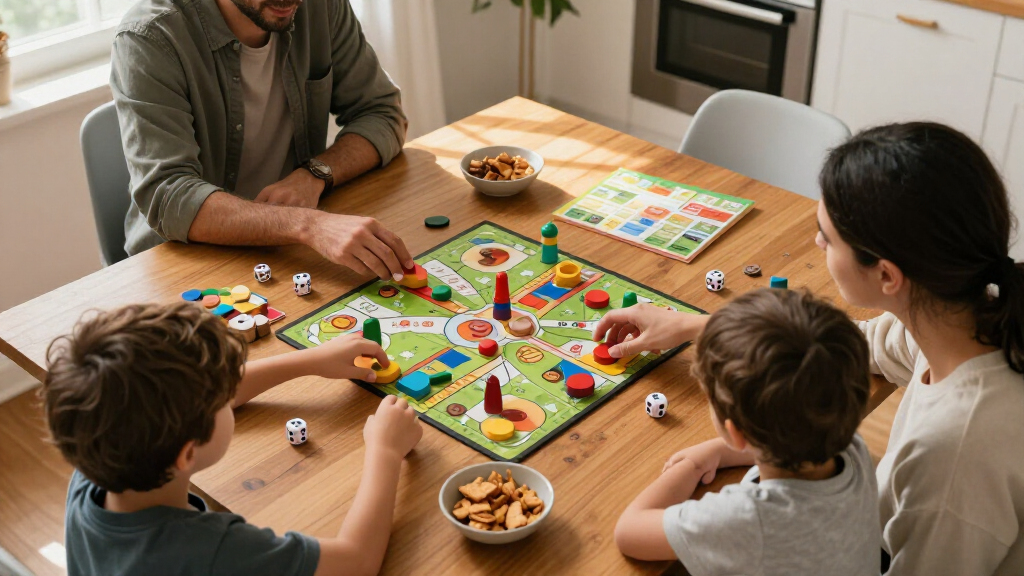

Choose a family-friendly board game, prepare it, and teach everyone how to play. This guide is for families with mixed ages or different levels of board-game experience. Set aside 30–60 minutes for choosing a game and playing a first round; the game’s own play time may vary.

Turn the school run and nap time into listening time
- Thousands of audiobooks, podcasts and originals
- Listen on your phone, tablet or Echo — also offline
- Cancel anytime

Sounds Fishy Bluffing Trivia Board Game for Families
- ✔ Players: 4–10
- ✔ Recommended age: 10 years and up
- ✔ Playing time: About 15 minutes
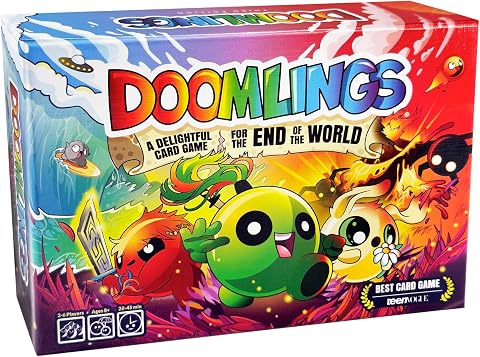
Doomlings Remastered Edition Card Game
- ✔ Players: 2–6
- ✔ Recommended age: Listing conflicts between 8+ and 10 years and up
- ✔ Playing time: About 30 minutes
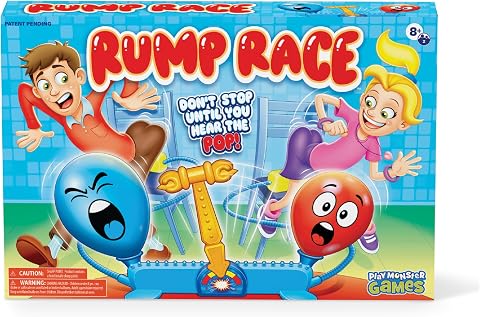
Rump Race Balloon-Popping Battle Game
- ✔ Players: 2
- ✔ Age range: 8 years and up
- ✔ Included components: Pumps, popping arrow, 30 balloons
Difficulty: Beginner | Time: 30-60 minutes
What You’ll Need
Tools & Materials:
- A board game with all required pieces
- A table or clear floor space
- The rulebook, including any age or player-count guidance
- A timer, if you want to limit turns or play time
Knowledge:
- Basic counting or reading may help, depending on the game
- No previous board-game experience is required
Check the box for the recommended age, player count, and estimated play time. Those are useful starting points, but children’s reading skills, patience, and comfort with competition also matter. If you do not own a suitable game, borrow one or ask a game library or shop to recommend a short, easy-to-teach option.
Sounds Fishy Bluffing Trivia Board Game for Families
Sounds Fishy earns the top spot because its simple premise turns a group into the entertainment: players invent answers to trivia prompts and try to steer the guesser toward a bluff. That gives relatives who know lots of facts and those who simply enjoy being funny a shared way to take part. At about 15 minutes per game, it is also easier to fit into a busy evening than Doomlings’ roughly half-hour card session.The catch is in the format. This is a game for at least four players, so it cannot fill the same small-group niche as Doomlings, and its bluffing depends on players being comfortable improvising. Families who prefer clear-cut trivia answers may find the invented responses distracting. The included 20 bonus question cards add prompts, but do not change the core reliance on bluffing. For a larger gathering that wants quick conversation and playful deception, it is the most broadly appealing choice in this lineup.
Pros:
- Quick-to-learn format suited to casual family gatherings
- Supports groups of four to ten players
- Short stated play time of about 15 minutes
- Includes 20 bonus question cards in this edition
Cons:
- Requires players to enjoy inventing answers and bluffing
- Cannot accommodate a family group smaller than four
Best for: Families and mixed groups of four to ten who enjoy quick rounds, trivia prompts, and making up funny answers.
Not ideal for: Households that usually play with fewer than four people or prefer trivia without bluffing and improvisation.
Bottom line: Choose Sounds Fishy for a larger family night where quick, funny conversation matters more than a strategic challenge.
“Choose Sounds Fishy for a larger family night where quick, funny conversation matters more than a strategic challenge.”
Doomlings Remastered Edition Card Game
When the family wants more decisions than a party prompt provides, Doomlings Remastered is the better fit. Players build a species by playing cards with traits and abilities, creating a more tactical rhythm than Sounds Fishy’s improvised answers. Its two-to-six-player range also makes it the most adaptable option here for a couple, a small family, or a modest group. Setup is described as quick, with a play time around 30 minutes.That flexibility comes with a longer commitment and more to keep track of: the box lists 167 unique cards, so families looking for an instantly understood party activity may favor Sounds Fishy instead. The supplied age details conflict, naming both 8+ and 10 years and up; the more cautious listed guidance is 10 years and up. It is not the pick for children below that guidance without an adult checking whether the rules suit them. Compared with Rump Race, Doomlings keeps everyone involved through shared card play rather than a two-person physical contest.
Pros:
- Works with two to six players
- Unique card traits and abilities support varied play
- Quick setup and an approximately 30-minute session
- Includes 167 unique cards and a rulebook
Cons:
- Takes longer than Sounds Fishy’s stated 15-minute play time
- Conflicting age guidance is provided in the listing
- Card abilities may be less accessible to players who want a very simple game
Best for: Families with two to six players who want a card game with evolving choices and more strategy than a quick party game.
Not ideal for: Players seeking a very short, purely social game, or families relying on clear age guidance for children under ten.
Bottom line: Pick Doomlings when player-count flexibility and card strategy matter more than the shortest possible round.
“Pick Doomlings when player-count flexibility and card strategy matter more than the shortest possible round.”
Rump Race Balloon-Popping Battle Game
Rump Race takes family game night away from the card table: two players bounce on pumps to inflate balloons while a popping arrow moves toward the opponent. That physical contest gives it a distinctly energetic feel compared with Doomlings’ strategy and Sounds Fishy’s conversation. For a sibling matchup or a parent-and-child challenge, the direct head-to-head format is easy to understand and designed for ages eight and up.Its focus is also its main limitation. The game supports two players only, making it a poor centerpiece when the whole family wants to play together. It also requires balloons, and the package includes 30; families should expect to supply replacements if they want to keep playing after those are used. While the listing says it works with most standard-size balloons, it does not offer the group flexibility of either card game. Choose it for movement and a quick contest, not as an all-purpose option for varied family gatherings.
Pros:
- Energetic physical play distinguishes it from the two card-based options
- Designed specifically for two-player competition
- Includes 30 balloons to get play started
- Stated age range begins at eight years
Cons:
- Limited to two players
- Requires balloons to play and may need replacements
- Less suitable as a shared game for larger family groups
Best for: Two family members, ages eight and up, who want an active, face-to-face competition rather than a seated card game.
Not ideal for: Families needing one game for three or more players or anyone who wants to avoid balloon setup and replacements.
Bottom line: Rump Race is a niche but lively pick when two players want movement and a simple head-to-head challenge.
“Rump Race is a niche but lively pick when two players want movement and a simple head-to-head challenge.”
As an Amazon Associate we earn from qualifying purchases.
Before You Start
Pick a time when players can focus without rushing. Keep snacks and drinks away from cards and game pieces. If a child may put small pieces in their mouth, check the packaging for age warnings and choose a game without pieces that pose a choking risk.
Step-by-Step Instructions
Step 1: Agree on what the group wants
Ask the players what sounds fun: solving a puzzle together, racing, acting, building, or competing. Find out how much time everyone has and whether anyone would rather avoid reading, complex arithmetic, or direct competition. Use the answers to narrow the choices.
Tip:For a first game with younger children or new players, a short game with few rules is often easier to finish and teach.
Check: You have a shared idea of the preferred game style and the time available.
Step 2: Check the game’s fit
Read the box or game description for the recommended age, player count, play time, and key skills. Check whether the game needs an adult to read cards or manage setup. Choose a title that includes everyone who will play and fits the group’s attention span.
Tip:A listed minimum age is a guide, not a measure of a child’s ability. Look at the actions players must take and decide whether they suit your group.
Check: Every player can take part in the main actions, and the expected game length works for the group.
Step 3: Review the rules and contents
Open the box and compare its contents with the inventory in the rulebook. Read the setup instructions and the rules for taking a turn, winning, and ending the game. Set aside any optional advanced rules for a later session.
Tip:Do not begin teaching until you know how a turn works and how the game ends. If a rule is unclear, check the rulebook’s examples or official publisher instructions.
Check: All listed pieces are present, and you can describe the setup, a typical turn, and the end condition.
Step 4: Set up the play area
Clear enough space for the board and pieces. Place the board where everyone can see and reach it, then follow the setup steps in the rulebook. Sort cards, tokens, and player pieces into easy-to-reach groups. Give each player a seat with a clear view.
Tip:Keep spare pieces and the box lid nearby so small components do not get lost between turns.
Check: The board is arranged as shown in the rules, and players can reach their pieces without crowding one another.
Step 5: Explain the goal and turn order
Tell the group what they are trying to do, how a player wins or how everyone succeeds together, and what happens when the game ends. Then explain the order of a turn in a few short actions. Show a card, board space, or piece when it helps make a rule clear.
Tip:Teach only the rules needed to begin. Explain unusual cases when they come up, and invite players to ask questions before the first turn.
Check: Each player can say what the group is trying to accomplish and identify whose turn comes first.
Step 6: Play a practice turn
Take one slow practice turn and talk through each action as it happens. Let players handle their own pieces where possible. Correct misunderstandings gently, and check whether everyone knows what choices they can make on a turn.
Tip:If the game has hidden information, explain what players should keep private before anyone looks at cards or pieces.
Check: Players can follow the turn order and know what they may do when their turn begins.
Step 7: Play the game and check in
Begin the first round. Keep the rulebook within reach and look up disputed rules instead of guessing. Give new players time to decide, and remind everyone to let the active player finish. If attention starts to fade, pause at a natural stopping point or agree to finish the round.
Tip:For younger players, an adult can read cards aloud or help with counting without making choices for them.
Check: The group follows the rules well enough to reach the game’s stated ending, and each player has had a chance to participate.
Step 8: Pack away and discuss the game
Count the pieces against the inventory before returning them to the box. Separate cards and components as the instructions recommend. Ask the players what they liked and whether they would play again; use their answers when choosing the next game.
Tip:Store the rulebook with the game and place small pieces in a bag or tray if the box does not keep them contained.
Check: The game is complete, its pieces are stored, and you know whether the group wants another round or a different game next time.
Common Mistakes to Avoid
- Choosing by the box’s age label alone. — Check the skills, reading demands, player count, and game length against the people who will play.
- Explaining every rule before anyone starts. — Teach the goal and basic turn first; explain exceptions when they arise.
- Starting without checking the pieces or setup. — Compare the contents with the inventory and follow the setup diagram before inviting the first turn.
- Letting one experienced player make decisions for a child. — Offer help with reading or counting, then let each player choose their own moves.
Troubleshooting
Problem: Players disagree about a rule.
Solution: Pause play and check the relevant rulebook section or an official publisher FAQ. Agree on one interpretation for the current game and apply it consistently.
Problem: A player loses interest before the game ends.
Solution: Pause at the next natural stopping point. If the rules allow it, shorten the session or let the player step away without disrupting the remaining players.
Problem: The game feels too difficult for younger players.
Solution: Read cards aloud, explain one decision at a time, or use a simpler game mode if the rules provide one. Keep children involved in making their own choices.
Problem: A piece is missing.
Solution: Check the box insert, floor, and nearby play area. If it is still missing, contact the publisher about a replacement and avoid substituting a piece that changes how the game works.
What Success Looks Like
The group completes a game using the published rules, every player understands the goal and gets a chance to participate, and the pieces return to the box. A good fit also means players are willing to play again or can explain what they would prefer in another game.
Next Steps
Write down the game’s play time and any rules that needed a reminder. At the next session, choose whether to replay it, try an optional rule, or pick a different title based on the group’s feedback. Store the game somewhere dry and keep small parts away from children who may swallow them.
Frequently Asked Questions
What makes a board game family-friendly?
It suits the group’s ages, player count, attention span, and comfort with reading or competition. A welcoming game gives each player a meaningful way to take part.
Should adults let children win?
Follow the rules and help children understand their choices rather than secretly changing the outcome. Cooperative games let the group succeed together if competition causes frustration.
How many games should we try at once?
Start with one. A short first game gives the group time to learn the rules and decide whether the game suits them before opening another box.
What can I do if my child cannot read the cards?
Read the text aloud and explain symbols before the turn. Check whether the game depends on private reading; if it does, choose a title that better matches the players’ reading skills.
Fall Picks
fall essentials
As an affiliate, we earn on qualifying purchases.