
TL;DR
A decade-old peer mediation program at H.L. Harshman Middle School in Indianapolis trains students to resolve classmate conflicts before they escalate. School leaders say the program has contributed to fewer fights and suspensions; discipline data shows the out-of-school suspension rate fell from a peak of 26% to 8% in 2024-25.
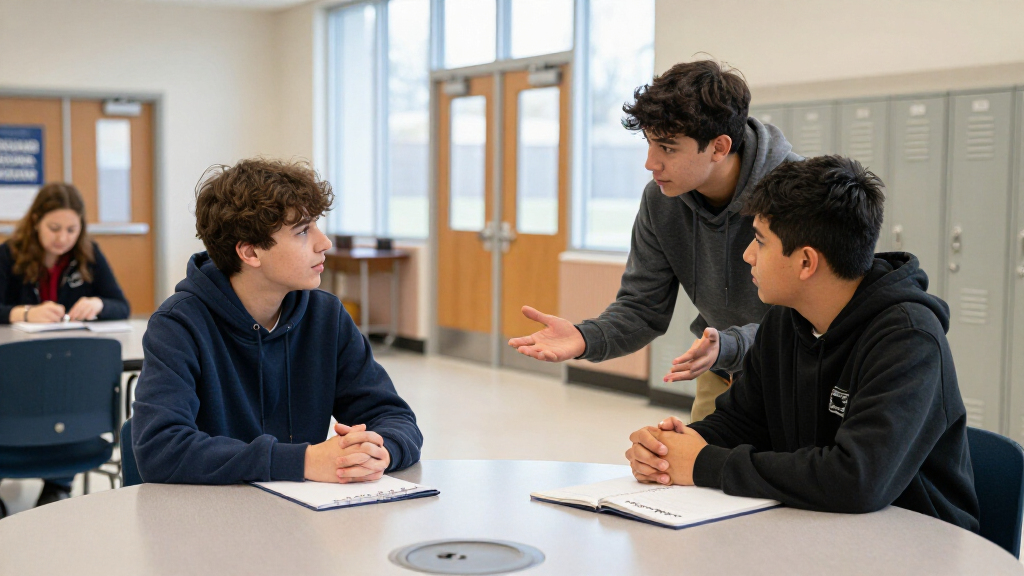
At H.L. Harshman Middle School on the near eastside of Indianapolis, students trained as peer mediators help classmates settle disputes before they escalate into fights — and school leaders say the decade-old program has contributed to a sharp drop in suspensions. Discipline data shows the share of Harshman students receiving out-of-school suspensions fell from a peak of 26% to 8% in 2024-25, according to the Richard M. Fairbanks Foundation, while statewide suspension rates remain slightly above pre-pandemic levels.

Turn the school run and nap time into listening time
- Thousands of audiobooks, podcasts and originals
- Listen on your phone, tablet or Echo — also offline
- Cancel anytime
The program, housed in educator Grover Edwards’ classroom, trains roughly 25 to 30 student mediators each year, selected from more than 100 applicants through an interview process. Mediators complete three weeks of after-school training before facilitating conflicts between classmates. Over the last school year, peer mediators handled about 25 peer conflicts, Edwards said, and he also facilitated restorative practice conferences as an alternative to traditional discipline.
The effort is supported by a $1.2 million grant from Indiana University Health that places trainers from the Peace Learning Center into Indianapolis Public Schools and Lawrence Township classrooms to teach conflict resolution for middle school conflicts, according to Tim Nation, executive director of the Peace Learning Center. Harshman leaders first contacted the organization about starting a peer mediation program in 2016, but Nation said it expanded after the IU Health donation and the hiring of Edwards, who has led the program for six years.
Students can request mediation by filling out a form in Edwards’ classroom. When a conflict is resolved, both parties sign an agreement not to discuss the argument outside the room, which mediators said builds trust in the process. Students most commonly seek mediation for fights between friends and conflicts over relationships, the mediators said — situations they described as harder to resolve than disputes over property.
Suspension Decline Stands Out Statewide
The drop at Harshman comes as suspension rates across Indiana remain elevated. About 6.5% of students statewide had an out-of-school suspension last year, slightly higher than before the pandemic, according to the report. Across Indianapolis Public Schools, the out-of-school suspension rate has held around 10% since 2022.
Harshman’s trajectory — from a 26% peak to 8% in 2024-25 — offers a case study for schools seeking alternatives to exclusionary discipline. Student mediators said classmates increasingly seek out mediation rather than fighting, in part because talking to peers carries less pressure than talking to adults. Principal Amy Moore said conflict resolution language has spread beyond the program, with students in hallways telling each other in jest, “That’s not the Harshman way.”
Products Worth Considering

LEGO Technic McLaren P1 Hypercar Building Set (42172)

LEGO The Legend of Zelda Great Deku Tree 2-in-1 Building Set

Owlet Dream Duo 3 Smart Baby Monitor System with Floor Stand
As an affiliate, we earn on qualifying purchases.
A Program Built Over a Decade
Harshman, which enrolls about 500 students, launched its peer mediation effort in 2016 when school leaders contacted the Peace Learning Center, Nation said. The program grew after the IU Health grant and after Edwards was hired. Similar peer mediation approaches have been used in New York City schools and elsewhere.
Peer mediation is designed to address conflicts before they become physical confrontations requiring adult intervention. Fairbanks Foundation discipline data shows Harshman’s out-of-school suspension rate began declining in 2016 before spiking shortly after the pandemic, then falling again from 2023 onward.
“Talking to an adult, you may be getting in trouble. When you’re talking to your peers there’s less pressure.”
— Isabell Gonzales, eighth grader and peer mediator
What the Data Does Not Prove
The claim that peer mediation caused the decline in fights and suspensions comes from school leaders, including Edwards and Moore, and cannot be isolated from other factors. The report does not detail what other discipline reforms, staffing changes, or restorative practice conferences may have contributed to the drop. Nation and school leaders attribute the program’s growth partly to the IU Health grant, but the report does not break down how grant funds were allocated or whether the grant is ongoing.
The report also does not specify how mediation outcomes are tracked beyond the roughly 25 conflicts handled last school year, or whether students who sign mediation agreements face follow-up if conflicts resume.
Whether the Model Spreads
The IU Health grant already places Peace Learning Center trainers in Indianapolis Public Schools and Lawrence Township classrooms, suggesting the approach could expand to additional middle schools in those districts. Similar programs have operated in New York City and elsewhere, though the report does not say whether other Indiana districts are considering adoption. Continued Fairbanks Foundation discipline data in coming school years will show whether Harshman’s 8% suspension rate holds or continues to decline.
Key Questions
What is peer mediation?
Peer mediation trains students to help classmates resolve disputes through facilitated conversation before conflicts escalate into fights requiring adult intervention. At Harshman, both parties sign an agreement at the end of a successful session not to discuss the dispute further outside the room.
How much did suspensions drop at Harshman Middle School?
According to Richard M. Fairbanks Foundation discipline data cited in the report, the share of Harshman students with out-of-school suspensions fell from a peak of 26% to 8% in 2024-25. Statewide, about 6.5% of students had an out-of-school suspension last year.
Who funds the program?
The program is supported by a $1.2 million grant from Indiana University Health, which places Peace Learning Center trainers in Indianapolis Public Schools and Lawrence Township classrooms.
How are student mediators chosen?
More than 100 students applied this year, with about 25 to 30 selected through an interview process, according to Edwards. Selected students complete three weeks of after-school training before mediating conflicts.
Is the suspension decline proven to result from peer mediation?
No. School leaders say the program contributed to fewer fights and suspensions, but the report does not isolate peer mediation from other factors that may have affected the school’s discipline data.
Source: rss