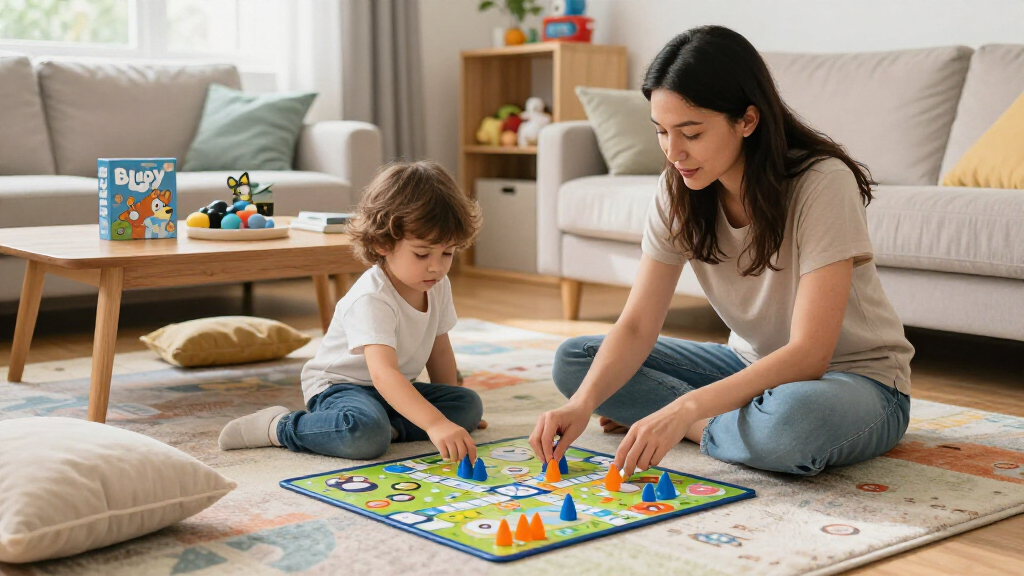
Among the best Bluey board games, I’d put Bluey Rubbish Run first for families who want a shared game with a clear goal, while Wonder Forge Bluey Matching Game is a simpler pick for younger players and Bluey Tumbling Tower brings lively, hands-on play. The main choice is between familiar board-game turns, memory and matching, and active games built around movement or suspense. Age fit, how much help younger children need, and whether the game works for mixed-age groups matter more than the Bluey theme alone. Some options are quick to set up, while others depend on special pieces or a more involved play style. Read on for my breakdown of all 15 picks and how to choose the right one for your family.

Get baby and family essentials delivered free — and shop member deals
- Fast, free delivery on millions of items
- Access to Prime Big Deal Days deals on October 6–7
- Prime Video, Amazon Music and more included
Complete the kit


Key Takeaways
- Rubbish Run leads for shared play: It offers a more collaborative family-game feel than the competitive race formats in Trouble and Candy Land.
- Matching is the easiest entry point: Wonder Forge’s Bluey Matching Game keeps the rules approachable, while Shopping List adds a memory-and-shopping theme for children ready for a little more structure.
- Hands-on games suit short, lively sessions: Tumbling Tower, Keepy Uppy, and Pop Up Bluey lean on physical action rather than long stretches of turn-taking.
- Classic game formats bring familiarity but more rules: Guess Who?, Monopoly Junior, and Operation suit households already comfortable with those styles; they may ask more of first-time players.
- The best fit depends on play style, not character count: Card games and matching are easy to bring out, while Splash Time, Scavenger Hunt, and motorized or action-based games have more specialized appeal.
| Hasbro Gaming Trouble: Bluey Edition Board Game |  | Best Overall | Brand: Hasbro Gaming | Players: 2–4 | Recommended age: 5 and up | VIEW LATEST PRICE | See Our Full Breakdown |
| Bluey Rubbish Run Family Board Game |  | Best for Hands-On Play | Brand: Bluey | Recommended age: 4+ | Players: Not specified | VIEW LATEST PRICE | See Our Full Breakdown |
| Bluey Tumbling Tower Game with 54 Illustrated Wooden Blocks |  | Best for Flexible, Skill-Based Play | Brand: Bluey | Item type: Tumbling Tower Game | Material: Wood | VIEW LATEST PRICE | See Our Full Breakdown |
| Spin Master Games Bluey Splash Time Board Game |  | Best for Splashy, Interactive Fun | Brand: Spin Master Games | Players: 2–4 | Recommended age: 5 years and up | VIEW LATEST PRICE | See Our Full Breakdown |
| Wonder Forge Bluey Matching Game for Kids |  | Best for Preschoolers | Brand: Wonder Forge | Game type: Matching game | Age range: 3 years and up | VIEW LATEST PRICE | See Our Full Breakdown |
| Goliath Don’t Wake Dad! Bluey Board Game |  | Best for Playful Family Suspense | Brand: Goliath | Players: 2–6 | Recommended age: 4 years and up | VIEW LATEST PRICE | See Our Full Breakdown |
| Hasbro Gaming Candy Land Bluey Edition Board Game |  | Best for Preschool Beginners | Brand: Hasbro Gaming | Players: 2–6 | Age range: 3 years and up | VIEW LATEST PRICE | See Our Full Breakdown |
| Bluey Cooperative Scavenger Hunt Board Game with 4 Character Figures |  | Best for Cooperative Play | Brand: Bluey | Players: 2–4 | Recommended age: 3 years and up; description also reports guidance ranging from 3+ to 5+ | VIEW LATEST PRICE | See Our Full Breakdown |
| Hasbro Gaming Guess Who? Bluey Edition Board Game |  | Best for Two-Player Trips | Brand: Hasbro Gaming | Players: 2 | Recommended age: 6 years and up | VIEW LATEST PRICE | See Our Full Breakdown |
| Bluey Shopping List Memory and Matching Game |  | Best for Memory Practice | Age range: 3 years and up | Players: 2–4 | Included components: 4 shopping lists, 2 shopping trolleys, 2 shopping baskets, 32 item tiles, 1 rules sheet | VIEW LATEST PRICE | See Our Full Breakdown |
| Hasbro Gaming Monopoly Junior: Bluey Edition Board Game |  | Best for First Property-Trading Games | Brand: Hasbro Gaming | Theme: Bluey | Players: 2–4 | VIEW LATEST PRICE | See Our Full Breakdown |
| Bluey Keepy Uppy Game with Motorized Balloon and Character Paddles |  | Best Active Bluey Game | Players: 2–3 | Recommended age: 4–13 years | Included components: 1 motorized Keepy Uppy balloon, 9 pop tokens, 1 instruction manual, and 3 paddles | VIEW LATEST PRICE | See Our Full Breakdown |
| TOMY Pop Up Bluey Family Action Game |  | Best for Quick, Simple Turns | Brand: TOMY | Game type: Board game | Players: 2–4 | VIEW LATEST PRICE | See Our Full Breakdown |
| Bluey Card Games 3-Pack, 6 Games in 1 |  | Best for Variety and Repeat Play | Brand: Moose Games | Age range: 4–15 years | Games included: Go Fish, Charades, and Crazy Eights | VIEW LATEST PRICE | See Our Full Breakdown |
| Operation Bluey Edition Board Game for Kids |  | Best for Solo Play and Dexterity | Brand: Hasbro Gaming | Players: 1 or more | Playing time: 10 minutes | VIEW LATEST PRICE | See Our Full Breakdown |
| Bluey board game | Included components | Brand | Players | Model number |
|---|---|---|---|---|
| Hasbro Gaming Trouble: Bluey E | Gameboard, 16 character pegs, and instructions | Hasbro Gaming | 2–4 | F4944 |
| Bluey Rubbish Run Family Board | 4 bin boards, 1 garbage truck, 36 rubbish tiles, and 1 rules sheet | Bluey | Not specified | — |
| Bluey Tumbling Tower Game with | 54 colorful wooden blocks and 1 game box | Bluey | — | 271C |
| Spin Master Games Bluey Splash | Bluey figure, showerhead, bathtub, gameboard, 4 movers, 4 tokens, die, and instructions | Spin Master Games | 2–4 | 6076526 |
| Wonder Forge Bluey Matching Ga | 72 picture tiles and instructions | Wonder Forge | — | 24730 |
| Goliath Don’t Wake Dad! Bluey | Couch, Dad, game board, 15 tokens, 6 characters, 6 bases, die, newspaper, sticker sheet, instructions | Goliath | 2–6 | 937448 |
| Hasbro Gaming Candy Land Bluey | 6 character movers, 6 plastic bases, 44 cards, Magic Xylophone, gameboard, and instructions | Hasbro Gaming | 2–6 | G1014 |
| Bluey Cooperative Scavenger Hu | 20 Find Cards, 10 Play Cards, 35 Toy Tokens, 1 Board, 4 Character Pawns | Bluey | 2–4 | 17144 |
| Hasbro Gaming Guess Who? Bluey | Game unit | Hasbro Gaming | 2 | G3609 |
| Bluey Shopping List Memory and | 4 shopping lists, 2 shopping trolleys, 2 shopping baskets, 32 item tiles, 1 rules sheet | — | 2–4 | 91068 |
| Hasbro Gaming Monopoly Junior: | Gameboard, 4 Junior tokens, 20 Chattermax cards, 4 character cards, 48 sold signs, 90 banknotes, die, and game guide | Hasbro Gaming | 2–4 | F5687 |
| Bluey Keepy Uppy Game with Mot | 1 motorized Keepy Uppy balloon, 9 pop tokens, 1 instruction manual, and 3 paddles | — | 2–3 | 90973 |
| TOMY Pop Up Bluey Family Actio | 1 Bluey figure, 1 barrel, and 24 crocodile sticks | TOMY | 2–4 | T73659US |
| Bluey Card Games 3-Pack | 165 cards and 3 instruction manuals | Moose Games | 2 or more | 91794 |
| Operation Bluey Edition Board | Gameboard, tweezers, 12 plastic ailments, 12 cards, and game rules | Hasbro Gaming | 1 or more | — |
More Details on Our Top Picks
Hasbro Gaming Trouble: Bluey Edition Board Game
Trouble: Bluey Edition is my strongest all-around pick for families who want a familiar board-game race with Bluey characters front and center. Players press the Pop-O-Matic die roller and move Bluey, Bingo, Chilli, or Bandit toward the finish, so the rules are quick to grasp and the central action gives younger players something satisfying to do each turn. Compared with Bluey Rubbish Run, this game has a simpler, less fiddly setup, though it offers less hands-on novelty than the truck’s spinning barrel and dump lever. The tradeoff is luck: players have limited control over their progress, and the game needs at least two people. I’d choose it for repeat family play, but not for a child looking for strategy or a solo activity.
Pros:- Recognizable Bluey, Bingo, Chilli, and Bandit playing pieces
- Pop-O-Matic roller makes taking turns tactile and easy to follow
- Simple setup and rules suit family game nights
- Gameboard and pegs can be packed for travel
Cons:- Dice results largely determine how quickly players advance
- Requires at least two players
- A race format may feel repetitive to children seeking varied tasks
Best for: Families with children ages 5 and up who want a straightforward, character-led racing game for two to four players.
Not ideal for: Solo players or children who prefer strategy and meaningful choices over luck-driven movement.
- Brand:Hasbro Gaming
- Players:2–4
- Recommended age:5 and up
- Playing time:30 minutes
- Included components:Gameboard, 16 character pegs, and instructions
- Language:English
- Model number:F4944
Our verdict“Choose Trouble: Bluey Edition for an easy-to-learn family race, provided your group is happy to let luck set the pace.”
Bluey Rubbish Run Family Board Game
Bluey Rubbish Run makes the game’s central action physical: players sort rubbish tiles into bins, load them into a truck, and use its spinning barrel and dump lever. That gives it a more playful, object-focused feel than the character race in Trouble: Bluey Edition, and sorting adds a simple task beyond moving pieces around a board. Surprise spills can return tiles to play, creating a funny setback rather than a predictable path to victory. That same randomness is the main drawback: a child who carefully sorts tiles may still lose progress, and the listed player count isn’t specified, so I’d check the instructions before buying for a particular group size. This is my pick for kids who enjoy manipulating game pieces, not for families seeking a clearly documented player count or a calmer, steady race.
Pros:- Spinning truck barrel and dump lever make the game physically interactive
- Sorting tiles gives children a simple task beyond racing
- Unexpected spills add a playful twist to turns
- Includes four bin boards for organizing the play area
Cons:- Spills can put rubbish tiles back into play and undo progress
- Player count is not specified in the supplied product details
- The truck and multiple tiles require more setup and handling than Trouble: Bluey Edition
Best for: Families with children ages 4 and up who enjoy sorting tasks and interactive toys they can operate during a game.
Not ideal for: Buyers who need a confirmed player count, or children who become frustrated when a random spill reverses their progress.
- Brand:Bluey
- Recommended age:4+
- Players:Not specified
- Included components:4 bin boards, 1 garbage truck, 36 rubbish tiles, and 1 rules sheet
- Materials:Paper, ABS, polypropylene, polyoxymethylene, and metal
- Recommended use:Indoor
Our verdict“Pick Rubbish Run for kids who want a hands-on sorting game, but check the rules for player capacity and expect setbacks.”
Bluey Tumbling Tower Game with 54 Illustrated Wooden Blocks
Bluey Tumbling Tower is the lineup’s most skill-led option: players take turns removing blocks and trying to keep the tower standing. Its 54 illustrated wooden blocks give the familiar tumbling-tower format a Bluey makeover, while balancing and careful block selection offer more direct player control than the die-driven race in Trouble: Bluey Edition. It also works well when a family wants a game that can be brought out for short turns without following a track or managing a complicated board. The tradeoff is that the tower can fall, ending a round abruptly, and this format may be less appealing to children who want a clear Bluey story or character-specific objectives. I’d choose it for shared dexterity play, not as the most distinctly Bluey-themed game in this group.
Pros:- 54 colorful wooden blocks feature Bluey and friends
- Block choices encourage focus, balance, and planning
- Wood construction offers a different feel from cardboard-tile games
- Can be played as a shared family activity
Cons:- The tower may fall and cut a round short
- Tumbling-tower play is less specifically tied to Bluey characters than Trouble: Bluey Edition
- Requires a stable surface and careful handling of stacked blocks
Best for: Families with children ages 3 and up who want a reusable dexterity game with a little more player control than a luck-based race.
Not ideal for: Bluey fans seeking a story-led board game, or children who dislike a tower collapsing and ending a round.
- Brand:Bluey
- Item type:Tumbling Tower Game
- Material:Wood
- Included components:54 colorful wooden blocks and 1 game box
- Recommended age:36 months to 15 years
- Model number:271C
Our verdict“Choose this tower game for Bluey-themed dexterity play and player choice, rather than a character-driven board-game race.”
Spin Master Games Bluey Splash Time Board Game
Bluey Splash Time puts a playful physical surprise at the center of its race: players move around the board while operating shower controls, and Bluey may shake water onto them. That real water-splashing action makes it a livelier choice than the dry, Pop-O-Matic turns in Trouble: Bluey Edition, especially for children who enjoy the bath-time gag. The downside is practical as well as strategic: play involves water, and getting sent back to start can mean repeating much of the race. It suits a family ready for a little mess and variable progress, rather than a quiet tabletop session. I’d pick Splash Time for its distinctive Bluey-themed action, but pass if damp clothes, cleanup, or long setbacks are likely to spoil the fun.
Pros:- Shower controls trigger real water-splashing play
- Bath-time theme gives it a distinct feel from standard racing games
- Includes Bluey figure, bathtub, gameboard, movers, and tokens
- Supports turn-taking and problem-solving during play
Cons:- Water can splash players and the surrounding play area
- A player sent back to start must repeat the race
- The surprise action makes progress less predictable than a straightforward board race
Best for: Families with children ages 5 and up who enjoy physical surprises and can play somewhere water splashes are manageable.
Not ideal for: Families seeking a dry, low-mess game or children who find returning to the start frustrating.
- Brand:Spin Master Games
- Players:2–4
- Recommended age:5 years and up
- Included components:Bluey figure, showerhead, bathtub, gameboard, 4 movers, 4 tokens, die, and instructions
- Model number:6076526
- Warranty:No warranty
- UPC:681147125278
Our verdict“Choose Splash Time for a memorable, water-based Bluey game if your play space and players can handle splashes and setbacks.”
Wonder Forge Bluey Matching Game for Kids
Wonder Forge Bluey Matching Game is the easiest fit for younger Bluey fans: its picture tiles turn familiar characters into a simple memory challenge, with quick rounds of about 15 minutes. Compared with Bluey Tumbling Tower, it asks less of a child’s balance and fine-motor control; the focus is on noticing and remembering pictures. The listed option also supports solo play, giving it more flexibility than Trouble: Bluey Edition, which requires at least two players. The tradeoff is limited complexity: older children may outgrow matching pairs sooner than they would a game with physical surprises or a race. Its cardboard tiles are also less robust than the wooden blocks in the tower game. I’d choose it for short, accessible play with preschoolers, not for a group wanting deeper strategy or lasting variety.
Pros:- Familiar Bluey, Bingo, Bandit, and Chilli artwork
- Quick rounds suit young children’s attention spans
- Matching play supports memory, focus, and visual recognition
- Can be played solo or with family
Cons:- Simple matching may not hold older children’s interest
- Cardboard tiles are less sturdy than the wooden blocks in Bluey Tumbling Tower
- Offers less physical interaction than Rubbish Run or Splash Time
Best for: Caregivers of children ages 3 and up who want short, screen-free Bluey play that can work solo or with family.
Not ideal for: Older children seeking complex choices, or households looking for durable wooden pieces and more varied gameplay.
- Brand:Wonder Forge
- Game type:Matching game
- Age range:3 years and up
- Included components:72 picture tiles and instructions
- Material:Cardboard
- Model number:24730
- Manufacturer:Ravensburger
Our verdict“Choose this matching game for accessible, short Bluey play with preschoolers, and skip it if your child wants a more involved challenge.”
Goliath Don’t Wake Dad! Bluey Board Game
Don’t Wake Dad! suits families who want a simple race with a little surprise built in. Players roll and move toward the pavlova, while certain spaces can send a player back to the start. That setback gives the game more dramatic swings than Bluey Shopping List Memory and Matching Game, which focuses on matching rather than a race. The rules are aimed at young children, and play for up to six makes it easier to include siblings or visiting family. The tradeoff is that movement relies on luck, so children looking for meaningful choices may find little to plan around. A setback can also feel frustrating when a player is close to the finish. I’d choose it for lively, low-complexity family turns, not for strategy or steady progress.
Pros:- Simple roll-and-move rules are approachable for young children.
- Surprise spaces create playful suspense during the race.
- Supports 2–6 players for larger family groups.
- Requires no batteries.
Cons:- Luck-based movement leaves players with limited strategic control.
- A triggered surprise can return a player to the start and disrupt progress.
Best for: Families with children ages 4 and up who want a Bluey race game that can include up to six players.
Not ideal for: Buyers seeking strategic choices or children who may become upset when a surprise sends them back to the start.
- Brand:Goliath
- Players:2–6
- Recommended age:4 years and up
- Play style:Roll and move
- Batteries:Not required
- Included components:Couch, Dad, game board, 15 tokens, 6 characters, 6 bases, die, newspaper, sticker sheet, instructions
- Dimensions:10.5 x 10.5 x 0.1 inches
- Language:English
- Model number:937448
Our verdict“Choose this for a larger group that enjoys simple Bluey races and surprise setbacks, but skip it if luck-driven reversals frustrate your child.”
Hasbro Gaming Candy Land Bluey Edition Board Game
Candy Land Bluey Edition is the easiest starting point here for preschoolers: players draw cards and follow the path, with no reading required. Its age guidance starts at 3, younger than Goliath Don’t Wake Dad!, and it accommodates up to six players. Bluey locations and the Dance Mode cards and Magic Xylophone space add theme-led moments without adding much complexity. That simplicity helps children join in quickly, but it also limits the challenge for older players who want choices or strategy. The listed playing time is 30 minutes, so it may feel long for a child who is ready for a quicker turn-based game such as Guess Who? Bluey Edition. I’d favor this for first board-game sessions, especially when reading ability varies around the table.
Pros:- No-reading card play makes it accessible to preschoolers.
- Supports 2–6 players, more than the two-player Guess Who? Bluey Edition.
- Dance Mode cards and the Magic Xylophone space add Bluey-themed interaction.
- Six character movers let players choose familiar characters.
Cons:- The straightforward path race may not hold older players’ interest.
- The listed 30-minute playing time may be lengthy for some young children.
Best for: Families introducing children ages 3 and up to board games, especially groups that need no-reading rules and room for up to six players.
Not ideal for: Families with older children seeking strategic decisions, or preschoolers who struggle to stay with a listed 30-minute game.
- Brand:Hasbro Gaming
- Players:2–6
- Age range:3 years and up
- Estimated playing time:30 minutes
- Edition:Bluey Edition
- Language:English
- Included components:6 character movers, 6 plastic bases, 44 cards, Magic Xylophone, gameboard, and instructions
- Model number:G1014
Our verdict“Pick Candy Land Bluey Edition for an inclusive first board game, but choose Guess Who? Bluey Edition for a shorter, more question-driven game with older children.”
Bluey Cooperative Scavenger Hunt Board Game with 4 Character Figures
Bluey Cooperative Scavenger Hunt makes teamwork the main event: players collect toy tokens together rather than race each other to finish. That shared goal gives it a different feel from Candy Land Bluey Edition, where each player follows a path toward the destination. The four character pawns—Bluey, Bingo, Bandit, and Chilli—and a mix of Find and Play cards give young children simple ways to take part. With space for two to four, it suits smaller groups but cannot match the six-player capacity of Candy Land or Don’t Wake Dad!. The supplied age details are inconsistent: the product data lists 3 years and up, while the description mentions guidance ranging from 3+ to 5+. I’d check the game’s packaging before buying for a younger child. Cooperative play is a plus, but buyers should not assume a single clear age recommendation.
Pros:- Cooperative objective encourages players to collect tokens together.
- Find Cards and Play Cards offer more than one way to engage with the hunt.
- Includes four familiar Bluey family character pawns.
- Designed for a compact 2–4-player group.
Cons:- Supports fewer players than Candy Land Bluey Edition and Don’t Wake Dad!.
- Age guidance is inconsistent in the supplied product information.
- No manufacturer warranty is listed in the supplied details.
Best for: Families with two to four young children who prefer shared goals and teamwork over competing to win.
Not ideal for: Larger groups needing more than four player spaces, or buyers who want consistent age guidance before choosing a game for a toddler.
- Brand:Bluey
- Players:2–4
- Recommended age:3 years and up; description also reports guidance ranging from 3+ to 5+
- Language:English
- Included components:20 Find Cards, 10 Play Cards, 35 Toy Tokens, 1 Board, 4 Character Pawns
- Characters:Bluey, Bingo, Bandit, and Chilli
- Edition:Standard Edition
- Manufacturer:Moose Toys
- Model number:17144
Our verdict“Choose this for a small group that values teamwork, but check age guidance and look elsewhere if you need room for a larger family.”
Hasbro Gaming Guess Who? Bluey Edition Board Game
Guess Who? Bluey Edition is the clearest choice in this group for two older children or an adult and child who enjoy asking questions. Players use yes-or-no clues to identify a mystery character or favorite object, so each turn involves more deduction than the luck-driven movement in Don’t Wake Dad! Its 15-minute play time and fold-up cases that connect for storage suit travel or a quick game between other activities. The age recommendation starts at 6, making it less suitable as a first board game for preschoolers than Candy Land Bluey Edition. Its biggest limitation is also plain: it is built for exactly two players. The double-sided sheets add variety, but they do not solve the group-size restriction. I’d choose it for a portable head-to-head game, not family game night with several children.
Pros:- Yes-or-no questions give players more deduction than a roll-and-move race.
- Double-sided sheets feature characters and favorite objects.
- Fold-up cases connect for easier storage and travel.
- Listed 15-minute play time suits short sessions.
Cons:- Designed for only two players, unlike the 2–6-player Candy Land Bluey Edition.
- Recommended for ages 6 and up, so it is less suited to preschoolers.
- The supplied component list names only the game unit, with no further component breakdown.
Best for: Two-player households with children ages 6 and up who want a portable Bluey deduction game for travel or short play sessions.
Not ideal for: Families needing a game for three or more players, or preschoolers who are not ready for question-based deduction.
- Brand:Hasbro Gaming
- Players:2
- Recommended age:6 years and up
- Play time:15 minutes
- Material:Plastic
- Included components:Game unit
- Edition:Bluey Edition
- Model number:G3609
Our verdict“Pick Guess Who? Bluey Edition for portable, two-player deduction with an older child; choose a group game if more players need to join.”
Bluey Shopping List Memory and Matching Game
Bluey Shopping List Memory and Matching Game gives young players a clear goal: match items to a shopping list and fill a trolley. That makes it a better fit for practicing memory, matching, and taking turns than Guess Who? Bluey Edition, which relies on asking and interpreting yes-or-no clues and is recommended for older children. The age range starts at 3, with room for two to four players. The shopping lists and item tiles create a tangible task, but the listed components include just two trolleys and two baskets, so the setup may not provide a full trolley for every player. It also requires at least two participants, ruling it out for solo play. I’d choose it for a preschooler who enjoys matching activities, not for a household that needs a one-player option or a complex board-game challenge.
Pros:- Shopping-list goal turns matching into a clear, child-friendly task.
- Encourages memory, matching, and turn-taking.
- Supports 2–4 players, while Guess Who? Bluey Edition is limited to two.
- Includes Bluey family-themed pieces and multiple shopping lists.
Cons:- Requires at least two players, so it does not serve as a solo activity.
- Includes two trolleys and two baskets for up to four players.
- Paper is the listed material, which may be less suited to rough handling than plastic components.
Best for: Families with children ages 3 and up who want a shared memory-and-matching activity for two to four players.
Not ideal for: Solo players, or families seeking a more strategic game with deeper choices than matching shopping items.
- Age range:3 years and up
- Players:2–4
- Included components:4 shopping lists, 2 shopping trolleys, 2 shopping baskets, 32 item tiles, 1 rules sheet
- Material:Paper
- Language:English
- Dimensions:10.5 x 1.97 x 10.5 inches
- Model number:91068
Our verdict“Choose this for preschoolers who enjoy shared matching and memory play, but skip it if you need solo play or a trolley for every participant.”
Hasbro Gaming Monopoly Junior: Bluey Edition Board Game
Monopoly Junior: Bluey Edition gives younger players a Bluey-themed introduction to buying locations and collecting money, with simpler play than standard Monopoly. Familiar characters and places help make the board approachable, while the 2–4 player format suits family game time. Compared with the fast physical action of Bluey Keepy Uppy, this is a quieter, more turn-based choice that asks children to follow a sequence and handle basic transactions. The tradeoff is its 30-minute estimated playtime: it asks for more sustained attention than a quick pop-up game such as TOMY Pop Up Bluey. Its age recommendation starts at five, so families with younger preschoolers may prefer a simpler option. I’d choose it for children ready to move beyond matching and luck-based games, not for a very short activity.
Pros:- Bluey characters and familiar locations give the board strong theme appeal
- Simplified Monopoly play is aimed at younger players
- Supports up to four players
- Includes character tokens, cards, sold signs, and banknotes for themed play
Cons:- The estimated 30-minute session may be long for children with short attention spans
- The age recommendation of five and up rules out younger preschoolers
Best for: Families with children ages 5 and up who want a Bluey-themed first taste of property trading and turn-based play.
Not ideal for: Families with children under five or anyone seeking a very short, active game with minimal rules.
- Brand:Hasbro Gaming
- Theme:Bluey
- Players:2–4
- Recommended age:5 years and up
- Estimated playing time:30 minutes
- Language:English
- Included components:Gameboard, 4 Junior tokens, 20 Chattermax cards, 4 character cards, 48 sold signs, 90 banknotes, die, and game guide
- Model number:F5687
Our verdict“Choose this for a Bluey fan ready for a longer, turn-based game with simple buying and collecting.”
Bluey Keepy Uppy Game with Motorized Balloon and Character Paddles
Unlike the mostly seated turns in Monopoly Junior: Bluey Edition, Keepy Uppy makes the central task physical: players use character paddles to keep a motorized balloon in the air and away from the hedge. That active format suits children who enjoy movement and quick reactions more than managing cards or money. The pop-token challenge adds a shared goal, so the game can prompt teamwork as well as reflexes. It supports just two or three players, however, while the TOMY Pop Up Bluey Family Action Game accommodates up to four and is easier to play in a larger family group. The balloon’s motion is the main attraction, but it also means players must stay engaged throughout the round. I’d pick this for a small, energetic group, not for quiet play or a busy gathering.
Pros:- Motorized balloon makes the play physically active
- Encourages reflexes and teamwork
- Bluey, Bingo, and Chilli paddles bring recognizable characters into play
- Pop tokens add a challenge beyond simply keeping the balloon aloft
Cons:- Limited to two or three players
- Players need to keep responding to the balloon throughout the game
- The active format is less suited to quiet or low-movement play
Best for: Two or three active Bluey fans ages 4 and up who enjoy cooperative challenges and fast reactions.
Not ideal for: Families needing a four-player game or children who prefer quiet, seated turns and slower-paced play.
- Players:2–3
- Recommended age:4–13 years
- Included components:1 motorized Keepy Uppy balloon, 9 pop tokens, 1 instruction manual, and 3 paddles
- Materials:Acrylonitrile-butadiene-styrene copolymer, polypropylene, electronics, metal, paper, polyvinyl chloride copolymer, and high-impact polystyrene
- Model number:90973
- UPC:630996909737
Our verdict“Pick Keepy Uppy for a small group that wants an active Bluey game rather than a seated board-game session.”
TOMY Pop Up Bluey Family Action Game
TOMY Pop Up Bluey keeps the rules simple: players slide crocodile sticks into a barrel and try not to trigger Bluey’s pop-up. Because the risky slot changes whenever the game resets, each round gets a fresh element of suspense without adding complicated instructions. Compared with Bluey Keepy Uppy, it is a seated, turn-by-turn option rather than an ongoing test of movement and reflexes; it also supports up to four players. The main tradeoff is the elimination mechanic: when Bluey pops out, a player is out, which can leave younger children watching instead of taking part. Its stated age range is 4–8, so older children may find the repeated surprise less involving than the varied play in the Bluey Card Games 3-Pack. This makes the most sense for short family turns with preschoolers.
Pros:- Simple turn structure is easy for young players to follow
- Changing pop-up slot gives resets a fresh uncertainty
- Supports two to four players
- Includes a Bluey figure and 24 crocodile sticks
Cons:- A player is eliminated when Bluey pops out
- The suggested age range tops out at eight
- Repeated stick placement offers less variety than a set with several different games
Best for: Families with children ages 4–8 who want an easy-to-explain, suspenseful game for short turns.
Not ideal for: Groups that want everyone involved until the end or older children seeking varied rules and longer-term strategy.
- Brand:TOMY
- Game type:Board game
- Players:2–4
- Recommended age:4 years and up
- Included components:1 Bluey figure, 1 barrel, and 24 crocodile sticks
- Material:Plastic
- Model number:T73659US
Our verdict“Choose this for quick, suspenseful rounds with younger children who are comfortable with elimination.”
Bluey Card Games 3-Pack, 6 Games in 1
For families who want more than one kind of play in a single set, the Bluey Card Games 3-Pack combines Go Fish, Charades, and Crazy Eights, with two ways to play each. That variety sets it apart from TOMY Pop Up Bluey, whose suspense comes from repeating the same simple turn structure. Here, matching and number recognition sit alongside storytelling and turn-taking, so caregivers can choose a game to suit the group or mix things up across play sessions. It supports two or more players, though Charades and other group-oriented play can be less satisfying with only a pair. The 165-card set also requires players to sort between three packs and consult the relevant instructions, unlike a single-rule game that starts quickly. I’d choose it for playdates and households that value options; skip it if you want one compact, instantly familiar activity.
Pros:- Three named games offer six ways to play
- Activities cover matching, number recognition, storytelling, and turn-taking
- Supports two or more players
- The card format gives families several choices across play sessions
Cons:- Some games work better with a group than with only two players
- Three packs and instruction manuals mean more sorting than a single-game box
Best for: Families and playdate hosts looking for several Bluey-themed card activities for children ages 4 and up.
Not ideal for: Buyers who want a single, self-contained game with no sorting between packs or who usually play with only two people.
- Brand:Moose Games
- Age range:4–15 years
- Games included:Go Fish, Charades, and Crazy Eights
- Ways to play:6
- Included components:165 cards and 3 instruction manuals
- Number of packs:3
- Players:2 or more
- Model number:91794
- UPC:630996917947
Our verdict“Choose this set for variety across family game nights and playdates, especially when the group size changes.”
Operation Bluey Edition Board Game for Kids
Operation Bluey Edition stands out for its one-player option and careful-hand coordination challenge: players remove 12 ailments with tweezers while trying not to set off the buzzer. That gives it a different role from Monopoly Junior: Bluey Edition, which is built around group turns and transactions, and from Keepy Uppy’s moving-ball reflex play. Hospital mode offers the classic approach, while Emergency mode adds a race against the clock, giving families two ways to use the same board. The handled case and built-in drawer make storage easier, but the game requires three AA batteries that are not included. It is also recommended for ages six and up, older than several Bluey options here. Since a buzzer ends a turn when the tweezers touch the sides, children who dislike precision pressure may prefer a less delicate game.
Pros:- Supports solo play as well as group play
- Hospital and Emergency modes provide different challenges
- Handled case and built-in drawer keep pieces together
- Includes 12 themed ailments and Bluey show music and phrases
Cons:- Requires three AA alkaline batteries, which are not included
- Touching the sides with the tweezers triggers the buzzer and ends the turn
- Recommended for ages six and up, making it less suited to younger Bluey fans
Best for: Bluey fans ages 6 and up who want a dexterity challenge that can be played alone or in a group.
Not ideal for: Younger preschoolers, players who dislike precision tasks, or buyers who want a game ready to play without supplying batteries.
- Brand:Hasbro Gaming
- Players:1 or more
- Playing time:10 minutes
- Age range:6 years and up
- Edition:Bluey
- Modes:Hospital and Emergency
- Included components:Gameboard, tweezers, 12 plastic ailments, 12 cards, and game rules
- Storage:Handled case with built-in drawer
- Batteries:Requires 3 AA alkaline batteries; not included
Our verdict“Pick Operation Bluey for older children who want a precision game with solo play and two modes.”
How We Picked
I compared the 15 games by how clearly their play style suits Bluey-loving families, how easy the rules are to learn, and how well each format can hold a child’s attention. I also weighed the likely role of adult help, whether players mostly compete or cooperate, and how much a game depends on distinctive pieces or an active play area. These factors matter because a familiar Bluey theme cannot make a poor age or household fit disappear.
The ranking favors games with an accessible central activity and a clear reason to choose them over similar options. Rubbish Run ranks ahead for its shared-play appeal; matching and simple physical games follow as approachable alternatives. Classic adaptations and more specialized formats rank lower when their rules, setup, or play style may narrow who enjoys them. I treat value as repeat-use potential and ease of bringing the game out, not as a price claim.
Factors to Consider When Choosing Best Bluey Board Games
Before choosing a Bluey game, I’d match the play experience to the child and the household, rather than relying on the box theme or a familiar game name. These broader checks can help avoid a game that looks appealing but rarely gets played.
Match the rules to the youngest player
Age guidance is a starting point, but children’s comfort with waiting, counting, matching, and following several steps can differ widely. A game that is simple for an older sibling may leave a younger child dependent on an adult for each turn. If the group spans ages, look for a format where younger players can take part without needing to read or plan several moves ahead. Adult support can make a complex game work, but it may also mean the adult is effectively hosting every round. Choose the level of help your household is happy to provide, not just the age printed on the package.
Choose competition or cooperation deliberately
Competitive games can suit children who enjoy racing, guessing, or trying to outscore a sibling, but losing may be the part they remember. Cooperative play gives the group a shared target and can reduce the pressure on a child who is still learning. Neither approach is automatically better: some children want clear winners, while others prefer to solve a task together. Think about how the players react when plans fail or someone finishes first. A mismatch between game mood and family mood can shorten play more than a slightly longer rulebook does.
Think about the room and the pieces
Board games do not all need the same kind of play space. A compact card or matching game can suit a small table or a quick visit, while physical-action formats may need room for players to reach, move, or handle pieces carefully. Before buying, check whether the game’s key components need to be arranged or protected between sessions. Small or distinctive pieces can make a game feel special, yet they are easier to misplace in a busy home. Pick a format that fits the surfaces, storage habits, and supervision available where the family usually plays.
Set expectations for session length and replay
A short activity can be easier to fit between meals or bedtime, while a longer game may work better for a planned family session. The advertised play time is only part of the decision: setup, rule explanations, and interruptions can stretch a round for young players. Repetition also matters. A simple matching game may be easy to replay, while a game built around a single surprise or action may depend more on whether that moment stays fun. Consider whether your child likes repeating a familiar routine or wants a changing challenge each time.
Pay for the play experience, not the theme alone
A licensed Bluey design can help a child feel excited to start, but the lasting fit comes from the game underneath it. Familiar mechanics such as memory, guessing, and race-to-the-finish play can be easy to explain, though they may feel familiar to adults who already own similar games. More unusual action formats can offer a different experience but may suit fewer occasions or players. Before choosing, ask whether the Bluey characters support an activity your child already enjoys. That question helps distinguish a game likely to come off the shelf from one chosen mainly for its packaging.
Frequently Asked Questions
Which Bluey board game is the easiest to introduce to a young child?
I’d start with Wonder Forge Bluey Matching Game if the child enjoys finding pairs and can take turns with a little help. Its core activity is easier to explain than a game with several kinds of moves or a longer sequence of rules. Shopping List is another memory-based option, but its shopping theme adds a different layer to the play. Keep the first session short and show a turn before expecting a child to manage the game alone. Check the manufacturer’s age guidance and piece details before buying.
Which pick is best when siblings want to play as a team?
Bluey Rubbish Run is the clearest choice in this lineup for families seeking a shared objective. That makes it a different kind of experience from competitive race games such as Trouble and Candy Land, where players advance against one another. Cooperative play can help siblings practice talking through a choice, though it may be less appealing to children who strongly prefer a winner. Think about whether your group enjoys solving a task together or would rather compete. For younger players, an adult can help keep decisions moving without taking over.
Are Bluey board games suitable for a mixed-age family?
They can be, but the best fit depends on how far apart the players are in age and game experience. Matching, card, and simple physical formats can make it easier for younger children to join, while Guess Who?, Monopoly Junior, or Operation may work better when players can follow their distinct rules and turns. Older siblings may need to give younger players time rather than rushing ahead. An adult can also adjust the pace or help with reading where appropriate. Check the age guidance and consider whether the older child will still find the activity engaging.
Should I choose a classic Bluey game adaptation or a more unusual activity game?
Choose a classic adaptation if your family already enjoys its familiar structure and wants the Bluey theme layered onto a known format. Guess Who?, Candy Land, Trouble, Monopoly Junior, and Operation each ask players to engage with a recognizable style of play, though the rules and pace vary. More unusual options such as Keepy Uppy, Tumbling Tower, or Splash Time may suit children who prefer movement or hands-on action. The tradeoff is that an unusual activity may have a narrower fit, while a familiar format may feel less novel to adults. Prioritize the way your child likes to play over the name on the box.
What should I check before buying a Bluey game as a gift?
First check the recipient’s age, comfort with rules, and whether they enjoy quiet table play, memory tasks, or active games. Then ask whether the household already owns a similar format; another race game may be less welcome than a cooperative or hands-on option. Storage and supervision matter too, especially for games with multiple pieces or a setup that needs room. If you do not know the child well, an accessible matching or card game can be easier to introduce than a specialized action format. Confirm the included components and current age guidance in the product listing before ordering.
Conclusion
For the best overall shared family experience, I’d choose Bluey Rubbish Run; for best value in repeatable, low-fuss play, the Bluey Card Games 3-Pack stands out for households that want several ways to play in a portable format. Wonder Forge Bluey Matching Game is my pick for beginners, while Bluey Tumbling Tower suits families after a hands-on activity rather than a traditional turn-by-turn board game. If you want a familiar classic, choose among Guess Who?, Candy Land, and Trouble based on the style your family already likes; for movement or a more unusual activity, look at Keepy Uppy or Splash Time. The right choice is the one that matches your child’s age, patience, and preferred way to play—not simply the game with the most recognizable format.
Halloween Picks
halloween
As an affiliate, we earn on qualifying purchases.