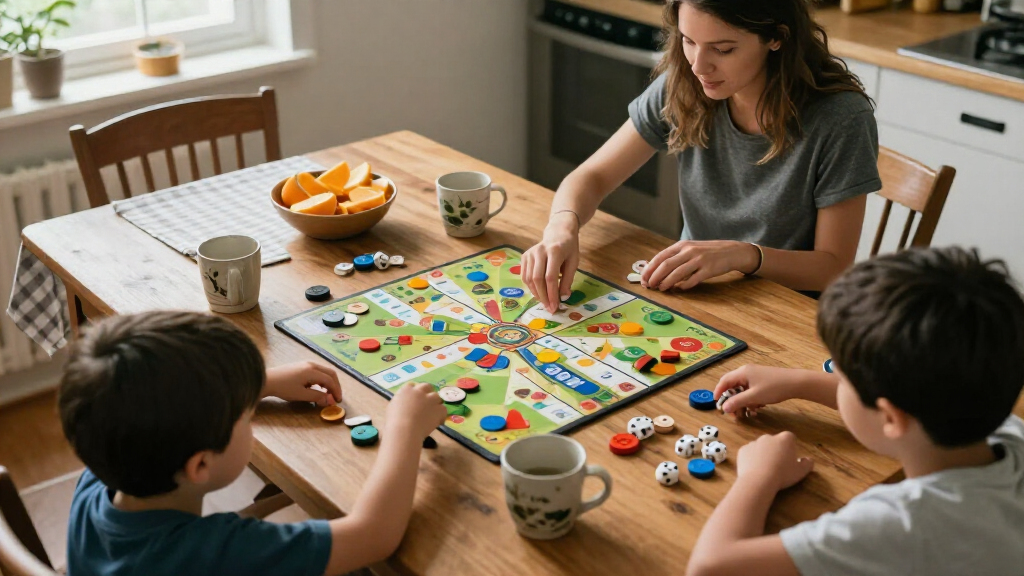

Families comparing Ticket to Ride and Carcassonne are usually choosing between a guided race and a more open-ended puzzle. Both turn a small set of rules into meaningful choices, work well for mixed-experience groups, and offer plenty of replay value. The difference is how players compete: Ticket to Ride makes routes, destination goals, and limited track space visible from the start; Carcassonne asks players to shape a map together, then decide when to claim its roads, cities, and fields.

Turn the school run and nap time into listening time
- Thousands of audiobooks, podcasts and originals
- Listen on your phone, tablet or Echo — also offline
- Cancel anytime

Hasbro Gaming Trouble Board Game
- ✔ Brand: Hasbro
- ✔ Age range: 5 years and up
- ✔ Players: 2–4

Hasbro Gaming Candy Land Kingdom of Sweet Adventures Board Game
- ✔ Brand: Hasbro Gaming
- ✔ Age range: 3 years and up
- ✔ Players: 2–4

Sorry! Board Game
- ✔ Brand: Hasbro Gaming
- ✔ Genre: Family board game
- ✔ Age range: 6 years and up
Ticket to Ride is the easier recommendation for families who want a clear objective, a colorful map, and a satisfying first game after a short rules explanation. Carcassonne suits groups who enjoy adapting as the board changes and negotiating over shared features. The best fit depends less on which game is more strategic than on whether your family prefers a race with personal goals or a shared landscape full of shifting opportunities.
At a Glance
| Criteria | Ticket to Ride | Carcassonne | Winner |
|---|---|---|---|
| Typical age and accessibility | The standard edition is generally recommended for ages 8 and up; familiar train routes and visible goals help new players. | The standard edition is generally recommended for ages 7 and up; matching tile edges makes early turns approachable. | B |
| Rules and first-game clarity | Collect colored cards, claim routes, and complete destination tickets; the central goal is easy to explain. | Draw and place a landscape tile, then choose whether to add a follower to a feature; scoring takes more explanation. | A |
| Player interaction | Players race for limited routes and can block connections, while most turns focus on personal plans. | Players share the developing landscape, may compete for features, and can join separate features into one. | Depends |
| Strategic depth | Plan connections and balance short-term route claims against longer destination goals. | Adapt to a changing board, judge when to claim, and weigh immediate points against long-term control. | B |
| Play time and group size | Typically 2–5 players, with a play time around 30–60 minutes depending on group and edition. | Typically 2–5 players, with a play time around 30–45 minutes. | Depends |
| Replay value | Different destination tickets and route plans create fresh races, though the map stays the same. | The board changes every game, and tile placement can reshape ownership and scoring. | B |
| Value for family use | A strong family centerpiece if the group likes a shared map and direct competition. | Good value for families who enjoy spatial puzzles and will replay a compact, expandable game. | Depends |
Hasbro Gaming Trouble Board Game
Trouble earns our overall spot because it gives families with young children a simple race they can start quickly, while its Pop-O-Matic bubble keeps the die attached to the game. That small design choice makes turns easy to follow and avoids the familiar search under the table. The game is listed for ages five and up and two to four players, which makes it a practical match for a household with early school-age children.Compared with Candy Land, Trouble asks players to count and move pegs rather than simply match colors, so it feels like a next step for children ready for a little more structure. Compared with Sorry!, however, its basic mechanics are easier to explain and its description emphasizes quick setup. The optional Power Up spaces provide a more challenging mode, though they do not turn Trouble into a deep strategy game.The main drawback is that the simplicity works both ways: older children and adults may want more decisions than rolling and moving provide. Pegs can also be bumped back to the start, creating the same kind of disappointment that can surface in Sorry!. Choose Trouble when easy rules and tactile turns matter more than strategic depth; skip it if your group prefers cooperative play or wants every move to be skill-driven.
Pros:
- Pop-O-Matic roller keeps the die attached and makes turns tactile.
- Rules and setup are described as easy for young children to pick up.
- Classic and Power Up modes offer a simple way to add a challenge.
- Supports two to four players and is listed for ages five and up.
Cons:
- The straightforward roll-and-move format may feel shallow to older players.
- A bumped peg can return to the start, which may frustrate children.
Best for: Families with children around age five and up who want a quick-to-learn race game for two to four players.
Not ideal for: Older children or adults who expect substantial strategy, or players who strongly dislike being sent back to the start.
Bottom line: Trouble is our most balanced recommendation for young families who value simple rules and an engaging physical die roller over deep strategy.
“Trouble is our most balanced recommendation for young families who value simple rules and an engaging physical die roller over deep strategy.”
Hasbro Gaming Candy Land Kingdom of Sweet Adventures Board Game
For a child who is still learning the basics of taking turns, Candy Land is the most accessible game in this group. Players follow a colorful path using a card deck, and the supplied description says no reading is required. At a listed age of three and up, it reaches a younger audience than Trouble or Sorry!, while its stated 15-minute playing time is easier to fit into a short play session.That simplicity is the point: compared with Trouble, Candy Land removes the need to manage pegs moving around the board, making it a gentler introduction for preschoolers. Compared with Sorry!, it also avoids the described mechanic of deliberately sending opponents back to start. The tradeoff is that movement depends largely on luck, so older siblings may find fewer meaningful choices and less reason to replay it.The game supports two to four players and includes instructions in English and Spanish. Families should keep the small plastic pawns away from very young siblings, as the provided product information flags them as a choking hazard. Candy Land makes the most sense when accessibility and a short session come first; as children want more agency, Trouble is a more natural step up.
Pros:
- No reading is required, helping preschoolers join without adult translation of cards.
- Color recognition, matching, and turn-taking are built into the play.
- Listed playing time is about 15 minutes.
- Instructions are provided in English and Spanish.
Cons:
- Movement is largely luck-based, with limited strategic depth.
- Older children and adults may find the gameplay repetitive.
- Small plastic pawns require care around younger siblings.
Best for: Preschool children and caregivers looking for a short, no-reading introduction to turn-taking and color matching.
Not ideal for: Families seeking strategic choices, extended replay value for older children, or components that can safely be left around younger siblings.
Bottom line: Candy Land is the strongest beginner choice for preschoolers, provided the family is comfortable with a simple, luck-led game and supervises small pieces.
“Candy Land is the strongest beginner choice for preschoolers, provided the family is comfortable with a simple, luck-led game and supervises small pieces.”
Sorry! Board Game
Sorry! is the pick for households that enjoy a more confrontational race. Players draw cards to move pawns, and the description highlights the chance to collide with opponents and send them back to start. That creates more dramatic swings than Candy Land’s color-path movement and gives each turn a little more consequence. Card draws encourage decisions, although luck remains a significant part of play.Among these three, Sorry! has the strongest take-that element. Trouble can also send a peg back after a bump, but its Pop-O-Matic roll-and-move structure is simpler; Sorry!’s card play makes its movement feel more varied. That added interaction may be a draw for families who enjoy teasing reversals, but it can also be a source of hurt feelings for children who find setbacks hard to accept.The listed age range begins at six and the game supports two to four players. Its biggest concern for family fit is the supplied 120-minute playing-time estimate, which is much longer than Candy Land’s listed 15 minutes and could be a mismatch for children with limited attention spans. Choose Sorry! when your family enjoys competitive twists and can tolerate a longer session. If quick, low-friction play is the priority, Trouble or Candy Land is a safer match.
Pros:
- Card draws create more varied movement than a basic color-path game.
- Offers direct interaction through collisions and sending opponents back.
- Listed for ages six and up and supports two to four players.
- Includes the board, pawns, cards, and instructions needed to play.
Cons:
- The listed 120-minute playing time may exceed many children’s attention spans.
- Luck can outweigh strategic choices.
- Sending another player back to start may cause frustration.
Best for: Families with children six and up who enjoy card-driven movement, playful rivalry, and surprising reversals.
Not ideal for: Younger children, players sensitive to setbacks, or households looking for a short game-night session.
Bottom line: Sorry! offers the most competitive interaction in this lineup, but its long listed session and potentially frustrating setbacks make it a selective family pick.
“Sorry! offers the most competitive interaction in this lineup, but its long listed session and potentially frustrating setbacks make it a selective family pick.”
As an Amazon Associate we earn from qualifying purchases.
Key Differences
The most visible distinction is the kind of plan each game asks a player to make. Ticket to Ride gives players destination tickets and a fixed map, so they can identify a route, collect the needed colors, and watch for rivals taking valuable connections. That structure makes progress easy for children to follow. It also creates moments when a route disappears, which can frustrate a player who has committed to a long plan. The competition is direct, but much of it happens through timing rather than constant confrontation.
Carcassonne replaces the fixed map with a landscape assembled during play. A tile can extend a city, bend a road, or open a chance to share a feature with another player. This makes each game feel different and rewards people who can revise a plan as new tiles arrive. The tradeoff is that scoring and ownership are less obvious to newcomers. A child can place tiles successfully before fully understanding why one follower placement may matter several turns later.
For a family buying one game, Ticket to Ride is the safer first pick when quick comprehension and a clear objective matter most. Carcassonne has the edge for groups who want a changing puzzle and more room to learn strategy over repeated games. Neither is a universal winner: the deciding factor is whether your table enjoys claiming routes toward private goals or building a shared board where ownership can change.
Detailed Comparison
Typical age and accessibility (Carcassonne wins — minor)
Carcassonne wins by a minor margin on the standard editions’ age recommendations: it is commonly listed for ages 7+, while Ticket to Ride is commonly listed for ages 8+. Both can work with younger children who can match shapes, count points, and wait through other turns, especially with an adult helping. Ticket to Ride’s familiar trains and colorful routes make its theme immediately legible; Carcassonne’s tile shapes are simple, but its scoring can require more adult explanation. In practice, the age label matters less than whether the child enjoys planning and can handle a route being blocked or a feature being contested.
Rules and first-game clarity (Ticket to Ride wins — moderate)
Ticket to Ride wins by a moderate margin. Players draw cards or spend matching cards to claim a route, and destination tickets explain why those connections matter. A first-time player can usually identify a useful move without mastering every scoring implication. Carcassonne’s turn is also short—draw and place a tile, then optionally place a follower—but players need to understand how cities, roads, monasteries, and fields score. That makes the initial teaching and end-game scoring more involved. Choose Ticket to Ride when a quick, confident start matters; choose Carcassonne if the group enjoys learning a small rules system as it plays.
Player interaction (moderate difference)
There is no single winner; the interaction depends on what your family likes. Ticket to Ride creates a visible race for limited routes. Taking a connection first can force another player to reroute, so competition is easy to notice and can feel sharp when a plan is blocked. Carcassonne produces subtler interaction: players may compete for a city or road, add tiles to another player’s feature, or connect separate features so they share points. That can prompt negotiation and surprise, but the consequences are not always clear to younger players. Ticket to Ride suits families who like straightforward rivalry; Carcassonne suits those who enjoy shared opportunities and shifting alliances.
Strategic depth (Carcassonne wins — moderate)
Carcassonne has a moderate edge for players who want a changing tactical puzzle. Tile placement affects the shape of the board, and follower supply limits how many features a player can claim at once. Players must judge whether to secure points now, wait for a feature to grow, or try to join an opponent’s area. Ticket to Ride offers meaningful planning too: players manage card colors, decide when to claim routes, and weigh ticket value against the risk of delay. Its fixed map gives newcomers more structure, while Carcassonne gives experienced players more ways to respond to the exact state of a game.
Play time and group size (minor difference)
This is a tie with a meaningful player-count caveat. Both standard games accommodate two to five players and often take roughly half an hour to an hour, depending on edition, pace, and how much the group discusses its turns. Ticket to Ride can feel especially tense at higher counts because popular routes fill quickly; that is exciting for some families and stressful for others. Carcassonne’s board grows with the number of turns, and the shared landscape can keep all players involved between turns. Check the edition’s listed player count and playing time before buying, since versions differ.
Replay value (Carcassonne wins — moderate)
Carcassonne wins by a moderate margin for variety from one session to the next. Its tile order and placement create a new map every time, changing which cities or roads are worth pursuing and how players can connect features. Ticket to Ride keeps the same central geography, but destination tickets and changing route priorities produce different plans and races. Families that enjoy learning one map deeply may find Ticket to Ride replayable for years; families who want the board itself to change will get more immediate variation from Carcassonne.
Value for family use (moderate difference)
The winner depends on what gets your family to the table. Ticket to Ride earns its cost when several relatives want a clear, social game that can be taught without much preparation and played repeatedly. Carcassonne offers strong value for families who want compact components, a new layout each time, and strategy that grows with experience. Both can support many evenings of play; expansions are optional ways to add variety, not requirements for a complete game. Compare the local prices and included content of the specific editions, since editions and bundles vary.
Ticket to Ride: Pros and Cons
Pros:
- A clear race and visible goals make the first game easy to follow.
- The fixed map helps children connect turns to longer plans.
- Limited routes create memorable competition and tactical decisions.
- Works well as a shared family activity for groups that like a lively contest.
Cons:
- A rival can take a route that a player has planned around, causing frustration.
- The board does not change between sessions, so variety comes mainly from new goals and plans.
- Players who dislike direct competition may find blocking routes uncomfortable.
Carcassonne: Pros and Cons
Pros:
- The board changes every game, making replay feel fresh.
- Tile placement and follower timing provide strategic choices that reward experience.
- Players can compete over features or find ways to share them.
- The standard age recommendation is slightly lower than Ticket to Ride’s.
Cons:
- Scoring and feature ownership take longer to teach and can be hard for children to track.
- The changing board can make it harder to plan far ahead.
- Its quieter competition may be less satisfying for families seeking a clear race.
Who Should Choose What
Choose Ticket to Ride if:
- Your family wants a game with a clear goal that children can grasp after a short explanation.
- Players enjoy planning routes and competing for limited spaces on a shared map.
- You want a strong first strategy game for a mixed-experience group.
Choose Carcassonne if:
- Your family enjoys spatial puzzles and adapting plans as the board develops.
- You value a different layout each session and expect to replay the game often.
- Your group is comfortable with a little more scoring explanation in exchange for flexible strategy.
Skip both if: Skip both if your family wants a cooperative game with no direct competition, or needs a very short game for children who are not yet comfortable waiting through turns. A cooperative title or a simpler game may fit better.
Value for Money
Paying more for either game makes sense only if its style matches what your family will actually replay. Ticket to Ride can justify a higher local price for households that want easy onboarding, recognizable goals, and a social race that works across ages. Its fixed map is a feature for players who like learning routes, but it may feel less fresh to a family that wants a different board each time.
Carcassonne is better value for families drawn to changing layouts and strategy that develops with experience. Its appeal does not depend on buying expansions, though add-ons can broaden play later. Since prices vary by edition and retailer, compare the actual box contents and player limits. If your family is unsure which style it prefers, a chance to try both before buying is more useful than paying extra for a larger bundle.
Final Verdict
For most families choosing one approachable strategy game, start with Ticket to Ride. Its clear route race is easier to teach, gives children an obvious reason to make each move, and creates satisfying competition without requiring constant rules reference. It is the stronger pick when ages and experience levels vary or when a smooth first game matters most.
Choose Carcassonne if your family prefers a new spatial puzzle each session and enjoys adapting plans as the shared landscape grows. Its scoring asks more of new players, but its changing board and flexible interactions reward repeat play. The biggest deciding factor is whether your table wants to race toward personal destinations or build and contest a map together.
Frequently Asked Questions
Which game is easier for children to learn?
Ticket to Ride is usually easier to teach because the core action is direct: collect cards and claim routes toward destination goals. Carcassonne has a simple turn, but its scoring and feature ownership need more explanation. A child’s age, patience, and interest in planning matter more than the age printed on the box.
Which game is better for two players?
Both standard editions support two players. Ticket to Ride makes the contest over limited routes especially visible, while Carcassonne becomes a quieter puzzle of tile placement and feature control. The better two-player choice depends on whether you want a route race or a changing landscape.
Which one has more replay value?
Carcassonne has more variation in the board itself because tiles create a different landscape each session. Ticket to Ride remains replayable through different destination tickets, card draws, and route choices, but the map stays fixed. Families who want each layout to change should favor Carcassonne.
Is Ticket to Ride worth paying more for?
It can be worth a higher price if your family values a clear objective, quick teaching, and a competitive shared map. If you would rather have a changing board and more flexible tile strategy, Carcassonne may offer better value. Compare the specific editions and their contents before deciding.