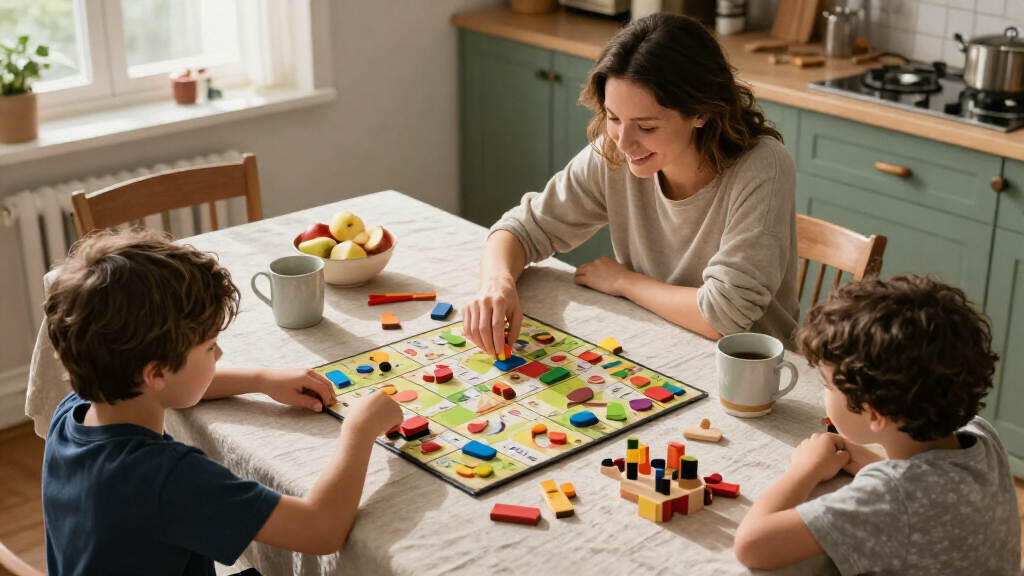

Choose a board game that fits your players’ ages, reading abilities, attention spans, and preferences, then set it up and teach the rules so everyone can join in. This guide is for families planning a first game night or picking a new game for a mixed-age group. Allow 30-60 minutes to select a game, read its instructions, and play a short session; the steps are beginner-friendly.

Turn the school run and nap time into listening time
- Thousands of audiobooks, podcasts and originals
- Listen on your phone, tablet or Echo — also offline
- Cancel anytime

Hasbro Gaming Candy Land Kingdom of Sweet Adventures Board Game
- ✔ Recommended age: 3 and up
- ✔ Players: 2–4
- ✔ Listed play time: About 15 minutes

Hasbro Gaming Trouble Board Game for Kids Ages 5 and Up
- ✔ Recommended age: 5 and up
- ✔ Players: 2–4
- ✔ Listed play time: About 30 minutes

Sorry! Board Game for Kids Ages 6 and Up
- ✔ Recommended age: 6 and up
- ✔ Players: 2–4
- ✔ Listed play time: About 120 minutes
Difficulty: Beginner | Time: 30-60 minutes, including choosing and learning the game
What You’ll Need
Tools & Materials:
- A board game with all listed components
- A flat table or clear floor space
- The game’s rulebook or official instructions
- A timer, if the game uses timed turns
Knowledge:
- Ages and approximate reading or counting skills of the players
- Basic willingness to take turns and follow shared rules
Count the players before selecting a game. Check the box for its recommended age and player range, but treat these as starting points: a child’s reading ability and comfort with competition matter too. If buying a game, check that it is available in a language everyone can follow.
Hasbro Gaming Candy Land Kingdom of Sweet Adventures Board Game
Candy Land is the easiest entry point in this group for families playing with preschoolers. The path, colored cards, and matching movement let children take turns without reading, which gives it a clear advantage over Trouble and Sorry! for kids who are still learning the basics of board-game play. Its stated minimum age is three, younger than the five-and-up recommendation for Trouble and six-and-up recommendation for Sorry!The simplicity is also its main limitation. Players draw and move, so families looking for meaningful choices or direct interaction may find that the game offers less to discuss than Trouble’s optional Power Up Spaces or Sorry!’s card-driven movement and pawn resets. Candy Land is listed for about 15 minutes, making it the shortest option here; that can help hold a young child’s attention, though a short race may not satisfy older children looking for a longer challenge.We would choose it for a first game with young children, especially when reading ability is a concern. Compared with the other two, it prioritizes accessibility and colorful storytelling over tactical decisions. Families with older siblings can still play together, but adults should expect a lightweight experience centered on taking turns and recognizing colors.
Pros:
- No reading is required to follow the basic color-matching play.
- The age recommendation starts at three, the youngest of these picks.
- Designed for two to four players, including a parent and young child.
- The listed 15-minute play time suits families seeking a brief activity.
Cons:
- Movement is largely determined by the cards, leaving little room for strategy.
- Its simple race may feel less engaging to older children than Trouble or Sorry!.
Best for: Families introducing children ages three and up to turn-taking, color matching, and their first board-game race.
Not ideal for: Older children and adults who want strategic choices, active player interaction, or a more involved game.
Bottom line: For families with preschoolers, Candy Land is the most approachable choice, provided the group is happy with a simple, luck-led race.
“For families with preschoolers, Candy Land is the most approachable choice, provided the group is happy with a simple, luck-led race.”
Hasbro Gaming Trouble Board Game for Kids Ages 5 and Up
Trouble gives a simple race a satisfying physical hook: players press the Pop-O-Matic bubble to roll, keeping the die attached to the game unit and making each turn easy to see. That tactile action helps distinguish it from Candy Land’s card draws, while the rules remain straightforward: get all four pieces around the board before opponents do. With a five-and-up age recommendation, it fits between Candy Land and Sorry! for families with children at different stages.Families can also choose between classic play and a version with Power Up Spaces, which adds an optional layer without requiring a different game. That flexibility makes Trouble a more adaptable pick than Candy Land when children are ready for a small increase in complexity. Compared with Sorry!, however, its listed play time is 30 minutes rather than the much longer 120 minutes supplied for Sorry!, and its core objective remains a relatively direct race.The setbacks matter: a peg can be bumped back to the beginning when another player lands on its space. That creates lively moments, but it can also frustrate a child who is close to finishing. We see Trouble as the best middle ground in this lineup for families who want accessible rules and a more interactive turn than Candy Land provides without stepping up to Sorry!’s older stated age range.
Pros:
- The Pop-O-Matic roller keeps the die in place and makes turns tactile.
- The stated age recommendation is five and up.
- Optional Power Up Spaces offer a more challenging version.
- The listed play time is about 30 minutes, shorter than Sorry!’s estimate.
Cons:
- A bumped peg returns to the beginning, which can be discouraging.
- The basic race offers less movement variety than Sorry!’s card system.
Best for: Families with children around five and older who enjoy pressing a physical die roller and want a simple, interactive race.
Not ideal for: Groups that dislike sending pieces back to the start or want the least competitive option for a sensitive young player.
Bottom line: Trouble is the strongest all-around middle choice for families wanting easy rules, a memorable die roller, and some competitive surprises.
“Trouble is the strongest all-around middle choice for families wanting easy rules, a memorable die roller, and some competitive surprises.”
Sorry! Board Game for Kids Ages 6 and Up
Sorry! is the most interactive and movement-driven pick of the three. Players use cards to move their pawns, and a landing can send an opponent back to the start. Compared with Trouble’s die-based lap around the board, Sorry! gives each turn more variation through card instructions and possible strategic choices. That makes it a better fit for families who want the race to shift as players affect one another.This added interaction brings a sharper competitive edge. The product description itself frames the experience around “sweet revenge,” and a pawn being returned to start can be a big setback. Families with younger or easily frustrated players may find Candy Land gentler; Trouble also has bumping, but Sorry!’s card movement and resets make the interaction central to its appeal. The age guidance is six and up, the oldest threshold in this roundup.One detail deserves attention when planning game night: the supplied product information lists a 120-minute estimated play time, much longer than the estimates for Candy Land and Trouble. We would not assume it will fit a short play window without checking the included instructions and your group’s pace. For families ready for a more involved race, Sorry! offers the strongest sense of changing fortunes; for a quick, lower-pressure introduction, the other two are better suited.
Pros:
- Card movement creates more varied turns than a straightforward die race.
- Landing on an opponent can send that pawn back, creating direct interaction.
- Designed for two to four players.
- Includes 12 pawns and 45 cards for the described gameplay.
Cons:
- The stated six-and-up age guidance makes it less accessible to the youngest children.
- The listed 120-minute play estimate is much longer than the other games here.
- Frequent setbacks may frustrate players who prefer a gentler family game.
Best for: Families with children six and older who enjoy direct competition, changing movement options, and the possibility of setbacks.
Not ideal for: Families seeking a very short, gentle first game or players who are upset by having a pawn sent back to the start.
Bottom line: Sorry! is the pick for families who want the most competitive, changeable race, as long as its setbacks and listed duration suit the group.
“Sorry! is the pick for families who want the most competitive, changeable race, as long as its setbacks and listed duration suit the group.”
As an Amazon Associate we earn from qualifying purchases.
Before You Start
Set a realistic goal: a short, enjoyable first session is more useful than finishing a long game when players are tired. Keep snacks and drinks away from cards and small pieces. For children who may put small objects in their mouths, check the packaging for age and choking warnings, and keep the components out of reach when the game is not in use.
Step-by-Step Instructions
Step 1: List who will play
Write down the number of players, their ages, and any needs that affect play, such as limited reading, color vision, fine motor control, or a short attention span. Ask each person whether they prefer teamwork, puzzles, building, storytelling, or friendly competition. Use these answers to narrow your choices.
Tip: For a mixed-age group, choose a game in which younger players can make meaningful choices without needing an adult to read every turn.
Check: You have a clear player count and a short list of preferences or access needs.
Step 2: Choose a suitable game
Compare the game’s player range, age guidance, play time, and core activity with your group. Pick one whose player count includes everyone and whose estimated session fits the time available. Read a description of how a turn works; avoid relying on the theme alone, since a child-friendly theme can still have complex rules.
Tip: If you are unsure, choose a cooperative game or one with a short play time. Players can learn together, and a shorter session makes it easier to stop while everyone is still engaged.
Check: The game supports your group size, fits the available time, and sounds appealing to the players.
Step 3: Check the components and rules
Open the box and compare its contents with the component list in the rulebook. Confirm that the board, cards, tokens, dice, and player pieces are present. Read the setup, turn sequence, and victory or ending conditions before inviting everyone to play. If a rule is unclear, check the game publisher’s official instructions.
Tip: Do not spend time sorting every piece before checking the setup directions; some games use only a portion of the cards or tokens in each session.
Check: All parts required for this session are present, and you can explain what players do on a turn and how the game ends.
Step 4: Prepare the playing area
Clear a surface with enough room for the board, draw piles, discard piles, and each player’s pieces. Sort components as the rules direct, place the board where everyone can see and reach it, and give each player the starting pieces or cards specified. Put unused components aside so they do not get mixed into play.
Tip: Seat players so younger children can see the board and reach their pieces without stretching across cards or knocking over tokens.
Check: Every player has the correct starting items, shared pieces are easy to reach, and the table is clear enough to play.
Step 5: Teach the rules in a short overview
Explain the goal first, then describe how a turn works and what choices a player can make. Show any special symbols or actions that players will encounter early. Keep exceptions brief; point to the rulebook when a rare situation comes up instead of trying to teach every possibility before play begins. Ask players to explain the goal or first action in their own words.
Tip: Use a sample turn to demonstrate the sequence. Let players see which pieces to move, what to draw, or where to place a card.
Check: Players can state the objective and know what to do when their turn begins.
Step 6: Play the first round together
Take turns in the order specified and guide the group through the first round. Remind players of legal choices when needed, and look up disputed rules rather than settling them by guesswork. Give children time to decide without taking over their turns. If someone wants to stop, pause and check whether the game offers a shorter ending or easy save point.
Tip: Keep the rulebook nearby. Agree to follow its wording for unclear situations so the same rule applies to everyone.
Check: Each player has taken a turn, and the group is following the same turn sequence.
Step 7: Finish, reset, and store the game
Follow the printed ending condition, then congratulate the group on completing the session. Ask which part they enjoyed and whether the game felt too easy, difficult, long, or competitive. Return cards, tokens, and pieces to their labeled bags or trays, and store the rulebook with the box.
Tip: If the group stops early, record any game state only if the rules explain how to save and resume. Otherwise, reset the game before storing it.
Check: The session ends according to the rules or an agreed stopping point, and the components are stored so they can be found next time.
Common Mistakes to Avoid
- Choosing by age label or theme alone — Check the player range, play time, reading demands, and what players do each turn. Match those demands to your group’s abilities and interests.
- Starting before reading the setup — Read the setup and turn sequence first. Incorrect starting pieces or shuffled decks can make the game confusing or require a full reset.
- Explaining every rule before the first turn — Teach the objective and basic turn, then introduce unusual rules when they arise. Use a sample turn to make the sequence easier to follow.
- Changing rules to help one player without telling the group — Agree on any house rule before play and apply it to everyone. For the first session, use the printed rules when possible.
Troubleshooting
Problem: The instructions are hard to understand
Solution: Read the setup and turn examples again, then look for official instructions from the publisher. Demonstrate a sample turn and resolve one question at a time.
Problem: A required piece is missing
Solution: Check inside the box insert, bags, and any folded board sections. If the piece is still missing, contact the seller or publisher for a replacement; do not substitute an item that changes how the game works.
Problem: Younger players lose interest before the game ends
Solution: Pause at a natural stopping point, or use a shorter game mode if the rules provide one. For the next session, choose a game with a shorter listed play time or simpler turns.
Problem: Players disagree about a move or rule
Solution: Pause play and check the relevant rulebook section. If it does not settle the question, agree on one interpretation for the current session and apply it consistently.
What Success Looks Like
You have selected a game that matches the group size and abilities, set it up using the instructions, and explained the goal and turn sequence. Players can take turns with a shared understanding of the rules, the session ends at an agreed or printed stopping point, and the pieces are ready to use again.
Next Steps
Use the group’s feedback to choose the next session. If players enjoyed the game but needed frequent reminders, play it again before introducing a new one. If it felt too long or difficult, try a shorter game with simpler turns. Store small pieces in their labeled bags, keep the rulebook in the box, and check the components before the next game night.
Frequently Asked Questions
How do I choose a board game for children and adults to play together?
Check that the player range includes everyone and consider reading, counting, and attention demands alongside age guidance. Cooperative games and games with simple turns can help mixed-age groups participate together.
Should I teach all the rules before we start?
Teach the objective, the basic turn sequence, and the choices players need right away. Explain less common rules when they come up, and use the rulebook to settle questions.
What should I do if a game takes longer than expected?
Check whether the rules include a short mode or a clear stopping point. If not, agree as a group to pause or end the session, then choose a shorter game next time.
How do I make a game night easier for a child who cannot read well?
Choose a game with few or no written instructions on cards, or have an adult read them aloud. Check whether players can understand choices through pictures, colors, or a demonstrated example.