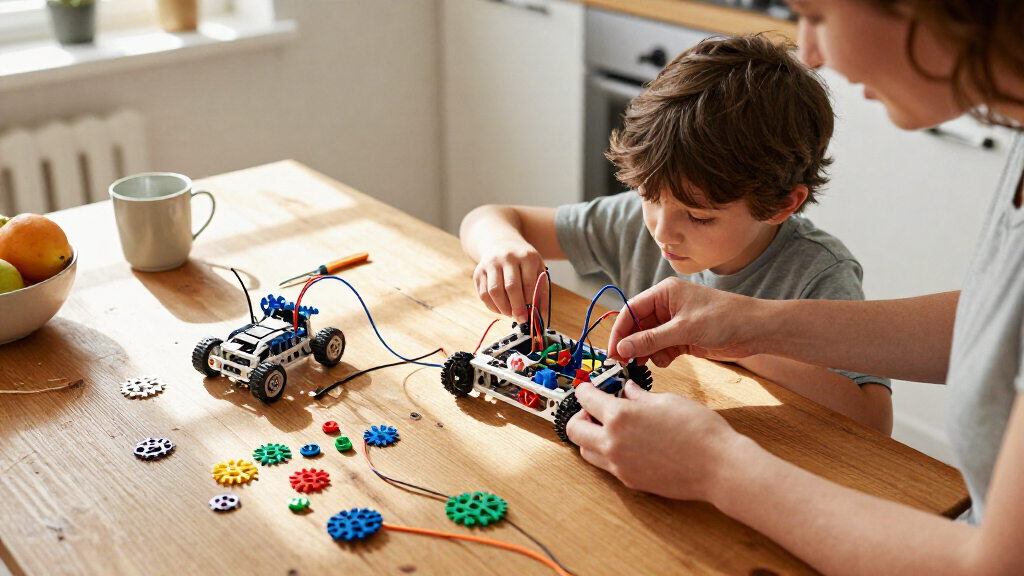

For most kids ages 8–13, I’d start with the Snap Circuits Arcade SCA-200: its hands-on electronic projects make cause and effect easy to explore, while the ThinkFun Gravity Maze is a standout for screen-free logic practice. Budding builders may prefer CrunchLabs The Crunchinator for a more involved mechanical challenge. The main tradeoff is between guided projects that offer a clear first step and open-ended kits that demand more patience, setup, or adult help. I compare all 15 picks by age fit, learning style, usability, and room to keep experimenting, so continue reading for the full breakdown.

Turn the school run and nap time into listening time
- Thousands of audiobooks, podcasts and originals
- Listen on your phone, tablet or Echo — also offline
- Cancel anytime
Complete the kit


Key Takeaways
- Snap Circuits Arcade SCA-200 leads for hands-on electronics: it centers the lineup on interactive circuit building, while Gravity Maze and Kanoodle focus on logic without electronics.
- The strongest choice depends on the kind of STEM play a child enjoys: solar robots and mechanical kits suit builders, circuit sets suit experimenters, and puzzles suit independent problem-solvers.
- Solar kits share a practical limitation: projects depend on suitable light, so they may be less dependable for indoor or cloudy-day play than tabletop kits.
- Age range alone does not reveal how much help a child may need: assembly detail, instruction style, and comfort with troubleshooting matter as much as the age printed on the box.
- One focused project can be more useful than many nominal builds: buyers should weigh repeatable experimentation and clear learning steps, not just the number of configurations listed.


| STEM toys for ages 8-13 | Brand | Recommended age | Model |
|---|---|---|---|
| Butterfly EduFields 10-in-1 ST | Butterfly EduFields | — | — |
| Bottleboom 13-in-1 Solar Robot | Bottleboom | 8–15 years | — |
| Snap Circuits Flight Deck STEM | Snap Circuits | — | SCFLTKIT |
| Smartivity DIY Robotic Mechani | Smartivity | 8–14 years | SMRT1135 |
| CrunchLabs The Crunchinator ST | CrunchLabs | 8–15 years | — |
| ThinkFun Gravity Maze Marble L | ThinkFun | — | — |
| Snap Circuits Arcade SCA-200 S | Snap Circuits | — | SCA-200 |
| Smartivity DIY Pinball Machine | Smartivity | 8–14 years | SMRT1169 |
| Sillbird 12-in-1 Solar Robot B | Sillbird | 10 years and up | US-SB-SolarRobot |
| Klutz LEGO Gear Bots STEM Acti | Klutz | — | — |
| Smartivity Hydraulic Paper Air | Smartivity | — | SMRT1163 |
| Thames & Kosmos My Robotic Pet | Thames & Kosmos | 8–12 years | 620507 |
| Educational Insights Kanoodle | Educational Insights | 7 years and up | EI-2978 |
| Snap Circuits Explorer SC-100 | — | 8 years and up | SC-100 |
| SCAEMO 4-Piece Solar and Wind | SCAEMO | 8–13 years | — |
More Details on Our Top Picks
Butterfly EduFields 10-in-1 STEM Electronics Robotics Kit for Kids Ages 8–12
The 10-project range makes this a strong pick for children who want to build several kinds of electronics and robotics projects from one kit. Its 100-plus components and illustrated instructions give kids a guided way to explore mechanics and basic electronics, while line following and obstacle avoidance add functions they can observe in action. Compared with the Bottleboom 13-in-1 Solar Robot Kit, this kit emphasizes electronics and robot behavior rather than solar-powered rebuilds. The tradeoff is that the product description warns some project components may not be included, so families may need to check the instructions before starting. It suits ages 8–12, but older kids looking for a longer age range or projects focused on renewable energy may prefer Bottleboom.
Pros:- Offers 10 robotics and electronics projects
- Includes more than 100 components for hands-on building
- Illustrated step-by-step instructions support guided assembly
- Line-following and obstacle-avoidance functions make robot behavior observable
Cons:- Some components needed for projects may not be included
- Its age range ends at 12, giving older children less room to grow into the kit
Best for: Ages 8–12 who want guided variety across robotics and basic electronics, especially children curious about line-following or obstacle-avoiding robots.
Not ideal for: Families who want every project component confirmed in the box, or older beginners who want a kit explicitly designed through age 15.
- Brand:Butterfly EduFields
- Age range:8–12 years
- Projects:10
- Components:100+
- Model number:506
- Included robot features:Line following and obstacle avoidance
Our verdict“Choose this for an 8–12-year-old who wants varied, instruction-led robotics projects and can work around possible missing project components.”
Bottleboom 13-in-1 Solar Robot STEM Kit for Kids Ages 8–15
For kids who enjoy taking a build apart and trying another configuration, the 13 rebuildable robot designs are this kit’s main advantage. Reusable gears, plates, tires, and shafts let children explore how changing a mechanism affects movement, while solar power introduces an energy concept through the build itself. Compared with the Butterfly EduFields 10-in-1 kit, Bottleboom offers more robot configurations and a wider stated age range, but less emphasis on specified electronic behaviors such as line following and obstacle avoidance. The ABS plastic parts are described as non-toxic and smooth-edged; however, assembly may call for adult-child teamwork. The product description also gives no detail about performance in low light, so it is a less certain choice for indoor play or places with limited sunlight.
Pros:- Supports 13 robot builds using reusable parts
- Solar power gives children a hands-on way to explore energy
- Parts can be disassembled and reused between builds
- Parts are described as non-toxic ABS plastic with smooth edges
Cons:- Assembly may require adult and child teamwork
- Low-light performance is not specified
- The description does not identify specific robot behaviors such as line following
Best for: Ages 8–15 who like rebuilding mechanical models and can test a solar-powered toy where it receives useful light.
Not ideal for: Children who want clearly specified electronic robot functions, or families whose play space has limited sunlight and who need dependable low-light operation.
- Brand:Bottleboom
- Recommended age:8–15 years
- Robot builds:13
- Power source:Solar
- Material:ABS plastic
- Manufacturer part number:2115A
- Included components:Solar robot toy parts
Our verdict“Pick Bottleboom for a child who values repeated mechanical rebuilds and solar-powered play more than defined electronic robot functions.”
Snap Circuits Flight Deck STEM Kit with Paper Airplane Launcher
The Flight Deck’s five projects focus on what happens when circuits produce motion: kids can launch paper airplanes, flying saucers, and balls, then explore a spinning wheel that makes patterns. That gives this kit a more playful, motion-centered angle than the Butterfly EduFields 10-in-1 kit, which leans toward robotics and electronic functions. Easy-to-follow instructions also make the Flight Deck a reasonable choice for children who want a guided activity without tackling a large set of robot builds. Its smaller project count is a real limit for kids seeking sustained variety, and batteries are not included, so the kit may not be ready to use straight from the box. Choose it for a focused introduction to circuits, motion, and air pressure rather than broad electronics exploration.
Pros:- Five hands-on projects explore circuits and movement
- Activities include launching objects and creating spinning patterns
- Covers air pressure alongside engineering and circuit concepts
- Easy-to-follow instructions support more independent building
Cons:- Batteries are not included
- Five projects offer less variety than the Butterfly EduFields or Bottleboom robot kits
Best for: Children aged 8 and up who learn best by seeing circuits create movement and want a short, guided set of experiments.
Not ideal for: Kids seeking many rebuildable projects or families who need a kit that includes batteries.
- Brand:Snap Circuits
- Model:SCFLTKIT
- Age range:8 years and up
- Projects:5
- Educational objectives:Critical thinking, problem solving, and STEM
- Included components:Flight Deck Kit
- Batteries:Not included
Our verdict“Choose the Flight Deck for a guided, motion-focused introduction to circuits, provided you have the required batteries.”
Smartivity DIY Robotic Mechanical Hand STEM Toy for Kids Ages 8–14
The Smartivity mechanical hand trades a collection of different builds for one tactile project: assembling a wooden robotic hand that connects robotics with anatomy. That focused subject makes it distinct from the Snap Circuits Flight Deck, which explores circuits through several motion-based activities, and from the multi-build Bottleboom robot kit. Step-by-step instructions support the assembly process, while the screen-free format suits families looking for hands-on construction without a device-led activity. Lifetime replacement parts are a helpful safeguard if pieces go missing or need replacing. The tradeoff is limited replay variety after the hand is assembled, and the listed dimensions are incomplete, making it harder to judge the project’s size before buying. Assembly also means this is not an instant-play toy.
Pros:- Connects robotics with anatomy through a mechanical hand build
- Screen-free activity with step-by-step instructions
- Engineered wood provides a distinct building material from plastic robot kits
- Includes replacement parts for the lifetime of the product
Cons:- Requires assembly before the hand can be used
- One central build offers less project variety than the Bottleboom or Butterfly EduFields kits
- Listed item dimensions are incomplete
Best for: Ages 8–14 who are interested in how hands work and prefer one guided, screen-free mechanical build over a set of separate projects.
Not ideal for: Children who want multiple robot builds, immediate play with no assembly, or families who need complete dimensions to plan storage.
- Brand:Smartivity
- Model:SMRT1135
- Recommended age:8–14 years
- Material:Engineered wood
- Theme:Anatomy and robotics
- Package quantity:1
- Listed dimensions:11.81 × 9.8 in; dimensions are incomplete
Our verdict“Choose this for a child who wants a focused, screen-free build that links hand anatomy with mechanical movement.”
CrunchLabs The Crunchinator STEM Toy by Mark Rober, Ages 8–15
The Crunchinator turns a simple question—what happens when force is applied to different objects?—into a hands-on crushing experiment. Its hand-cranked mechanism is described as multiplying strength 30 times, while three interchangeable plates let kids compare different crushing effects. A contained chamber is designed to make cleanup easier, and the phone holder can help children record and review experiments. Compared with the Snap Circuits Flight Deck, this is less about building circuits and more about observing force and mechanical action; unlike the multi-build Bottleboom kit, it centers on one activity rather than multiple robot designs. The key limitation is that objects to crush are not specified as included, and the accessory details are limited, so families may need to supply suitable test materials.
Pros:- Three interchangeable plates produce different crushing effects
- Hand-cranked mechanism makes force and mechanical action visible
- Contained chamber is designed to simplify cleanup
- Phone holder supports recording experiments
Cons:- Objects to crush are not specified as included
- The description gives limited detail about the five included accessories
- The activity focuses on crushing experiments rather than varied builds or electronics
Best for: Ages 8–15 who enjoy testing cause and effect, comparing mechanical outcomes, and recording experiments with a phone.
Not ideal for: Children who want electronics, robot-building variety, or an experiment kit with clearly specified test objects included.
- Brand:CrunchLabs
- Recommended age:8–15 years
- Crunch plates:3
- Model number:11601
- Included components:1 crunch toy, 2 googly eyes, 5 accessories, 1 wrench, and 1 instruction manual
- Mechanism:Hand-cranked; described as multiplying strength 30 times
- Additional feature:Contained chamber and phone holder
Our verdict“Choose the Crunchinator for a child who wants to investigate mechanical force through repeatable crushing tests, not a broad robotics or circuits kit.”
ThinkFun Gravity Maze Marble Logic Game
Gravity Maze is the strongest fit here for kids who enjoy solving a problem before building anything. Players arrange towers on a grid to create a marble path, with 60 challenges that progress from beginner to expert. That makes it easier to adjust the challenge than with a single-build kit such as the Smartivity DIY Pinball Machine, which focuses on assembly followed by play. Gravity Maze also works for solo puzzling or shared attempts, though its harder cards call for patience and careful planning. The tradeoff is a narrower kind of STEM play: it develops spatial reasoning and logic, but does not teach circuits or let kids construct a moving mechanism. I’d choose it for repeatable screen-free brainwork, not for a child who wants a project to build and keep playing with.
Pros:- 60 challenges provide a clear range from beginner to expert
- Tower placement gives hands-on practice with spatial reasoning and planning
- Supports solo play as well as collaborative problem-solving
- Compact component set avoids the extended assembly required by kits such as Smartivity DIY Pinball Machine
Cons:- Harder challenges can frustrate players who prefer quick wins
- Offers less open-ended construction than the Sillbird 12-in-1 Solar Robot Building Kit
- Primarily practices logic and spatial skills rather than circuitry or mechanical engineering
Best for: Families seeking a screen-free solo or cooperative logic challenge for an 8- to 13-year-old who likes spatial puzzles.
Not ideal for: Kids who mainly want to build a working machine, experiment with electronics, or play an open-ended construction game.
- Brand:ThinkFun
- Age range:8+
- Challenges:60 challenge cards, beginner to expert
- Included components:Game grid, 9 towers, 3 marbles, 1 target piece
- Model number:44001006
- Play style:Solo or collaborative
Our verdict“Choose Gravity Maze for a repeatable logic puzzle that builds spatial reasoning, but pick a construction kit if your child wants to make a working device.”
Snap Circuits Arcade SCA-200 STEM Electronics Kit for Kids Ages 8+
Snap Circuits Arcade suits kids who want to connect components and see electronic projects come to life without soldering or tools. Its color-coded snap parts lower the barrier to experimenting, while the instruction book offers more than 200 project ideas, including arcade-style activities. That gives it a broader electronics focus than the ThinkFun Gravity Maze, which develops logic through marble-path puzzles rather than circuits. It also offers more guided variation than the manually operated Klutz LEGO Gear Bots, whose projects center on mechanical motion. The 30 components make setup approachable, but the kit depends on three AA batteries that are not included. Children looking for free-form circuit design may also find the experience guided by the available parts and instructions.
Pros:- More than 200 project ideas support repeated experimentation
- Color-coded components snap together without tools or soldering
- Arcade-style activities give electronics practice a playful goal
- Instructional format introduces basic electricity, engineering, and circuitry
Cons:- Requires three AA batteries, which are not included
- The 30-component set may limit projects compared with electronics kits offering a larger parts selection
- Project-led circuit play is less suited to kids seeking mechanical building like the Klutz LEGO Gear Bots
Best for: Families looking for a tool-free introduction to electricity and circuits, especially for kids who like testing many guided projects.
Not ideal for: Buyers who want a battery-ready kit out of the box, soldering practice, or a physical construction project with a finished model to keep.
- Brand:Snap Circuits
- Model:SCA-200
- Age range:8+
- Components:30
- Projects:200+
- Batteries:3 AA batteries required; not included
- Tools required:None
- Assembly method:Color-coded components snap onto a grid; no soldering
Our verdict“Pick Snap Circuits Arcade for accessible, repeatable circuit experiments, provided you have the required batteries and your child prefers electronics to mechanical builds.”
Smartivity DIY Pinball Machine STEM Kit
Smartivity DIY Pinball Machine turns the build itself into part of the payoff: once assembled, the ramps, flippers, launcher, and scoring targets form a tabletop game. Its 375 parts and illustrated instructions give older children a substantial construction project, while the finished machine invites solo play or a family challenge. Unlike the ThinkFun Gravity Maze, which offers a sequence of separate logic puzzles, this kit leaves the builder with one playable mechanism. The tradeoff is time and patience before the first game; it is not a ready-to-play activity, and younger children may need adult help during assembly. Its 8–14 age guidance reaches a little beyond many options in this roundup, but kids who want electronics experiments may prefer Snap Circuits Arcade instead.
Pros:- Finished pinball machine supports play after the construction session
- Ramps, flippers, and a launcher make mechanical ideas visible through use
- Illustrated instructions support a guided build
- Lifetime replacement parts offer support if components need replacing
Cons:- Requires assembly before the machine can be played
- The 375-part build may call for adult help, particularly for younger builders
- Focuses on one finished game rather than the repeated challenge variety of ThinkFun Gravity Maze
Best for: Families wanting a collaborative build for ages 8–14 that becomes a playable tabletop game after assembly.
Not ideal for: Kids who want immediate play, dislike multi-part construction, or would rather experiment with electronics than build a mechanical game.
- Brand:Smartivity
- Model:SMRT1169
- Recommended age:8–14 years
- Included parts:375 parts and instructional manual
- Materials:Engineered wood, rubber bands, and marbles
- Dimensions:11 x 14.5 x 5.3 inches
- Weight:529.5 g
- Warranty:Lifetime replacement parts
Our verdict“Choose this kit for a hands-on family build with a playable result, not for quick setup or a broad series of separate projects.”
Sillbird 12-in-1 Solar Robot Building Kit, 190 Pieces
Sillbird’s 12-in-1 Solar Robot Building Kit stands out for letting builders reuse a 190-piece set across 12 models, from robots to cars. That repeated rebuild cycle can keep a mechanically curious child engaged longer than the single finished machine in the Smartivity DIY Pinball Machine. Solar power also gives the models a direct connection to renewable energy, but the light requirement affects where and when they work: indoor play calls for a strong artificial light source, and the kit does not include a battery fallback. Its recommended age starts at 10, making it a better match for older children in this 8–13 roundup than for an eight-year-old building independently. Compared with Snap Circuits Arcade, it emphasizes physical models and light-powered movement rather than electronic circuit experiments.
Pros:- 12 models provide multiple rebuilds from one set of 190 pieces
- Introduces solar power and engineering through moving models
- Can operate with sunlight or a strong artificial light source
- Step-by-step instructions support solo assembly or family building
Cons:- Indoor operation depends on a strong light source
- Recommended age begins at 10, so younger children may need added help
- No battery is included as an alternative when light conditions are insufficient
Best for: Families with a mechanically curious child aged 10–13 who wants to rebuild solar-powered models and can use them in strong light.
Not ideal for: Buyers seeking an easy fit for ages 8–9, reliable indoor operation in dim rooms, or battery-powered play regardless of sunlight.
- Brand:Sillbird
- Model:US-SB-SolarRobot
- Recommended age:10 years and up
- Number of models:12
- Number of pieces:190
- Power source:Solar; strong artificial light can also be used
- Material:ABS
- Dimensions:10.24 x 7.87 x 2.56 inches
Our verdict“Choose Sillbird for an older child who wants multiple solar-powered builds and has access to strong light, but skip it for younger builders or dim play spaces.”
Klutz LEGO Gear Bots STEM Activity Kit for Ages 8–12
Klutz LEGO Gear Bots is a good match for kids who want to understand why a mechanism moves, not just follow a build. The kit combines LEGO Technic elements with papercraft to make eight kinetic creatures, while its 64-page book explains axles, cams, and cranks in the context of each model. Turning a handle makes the mechanisms visible, giving the concepts a tangible result. Compared with the Smartivity DIY Pinball Machine, Gear Bots offers more distinct models and a more explicit focus on mechanical principles; the pinball kit, by contrast, ends in a playable game. These creatures are manually operated, so they will not move on their own, and the age range tops out at 12. I’d choose it for guided mechanical learning, not powered robotics or open-ended LEGO building.
Pros:- Eight kinetic creatures offer several builds rather than one finished model
- LEGO Technic elements and papercraft combine different construction approaches
- The 64-page book explains axles, cams, and cranks alongside the models
- Manual operation makes the connection between turning a handle and movement easy to observe
Cons:- Models require manual operation rather than moving under their own power
- Papercraft components may not appeal to kids who prefer all-plastic construction
- Age guidance ends at 12, while Smartivity DIY Pinball Machine is recommended through age 14
Best for: Ages 8–12 who enjoy LEGO-style construction and want guided, hands-on explanations of gears and motion.
Not ideal for: Kids seeking powered robots, open-ended building with a large LEGO collection, or a kit intended to span beyond age 12.
- Brand:Klutz
- Age range:8–12 years
- Models:8
- LEGO elements:62
- Papercraft sheets:10
- Book:64 pages
- Dimensions:10 x 1.5 x 10 inches
- Operation:Manual
Our verdict“Pick Klutz LEGO Gear Bots for guided learning about mechanical motion through several hand-operated builds, but choose another kit if powered movement is the goal.”
Smartivity Hydraulic Paper Airplane and Dart Launcher STEM Kit
Hydraulic motion meets aerodynamics in a build that gives ages 8–13 a visible reason to learn how pressure and levers work. The wooden launcher uses water-filled syringes to move its mechanism, then sends paper airplanes or soft-tip foam darts into flight. Compared with the Snap Circuits Explorer SC-100, this kit is less about exploring many concepts through repeatable projects and more about building one mechanical device, adjusting it, and seeing what happens.
That focused play suits kids who learn by launching, observing, and tweaking. Multiple paper airplane designs add variety, and the no-glue, no-screw assembly keeps the build approachable. The tradeoff is that setup comes before play, and the hydraulic system needs water in the syringe. I’d choose another kit for broad electronics practice or for a child who wants an activity ready straight out of the box.
Pros:- Demonstrates hydraulics and scissor mechanisms through a moving launcher
- Supports both paper airplane and foam dart launches
- Includes multiple airplane designs for repeat flight experiments
- No glue or screws are needed for assembly
Cons:- Requires assembly before the launching play begins
- The hydraulic mechanism needs water in its syringe
- Covers a narrower set of activities than multi-project electronics kits
Best for: Kids who enjoy building a working mechanism and experimenting with how airplane design affects flight
Not ideal for: Children seeking instant play or a broad sequence of projects, since this requires assembly and focuses on one launcher
- Brand:Smartivity
- Model:SMRT1163
- Age range:6–14 years
- Materials:Engineered wood
- Educational concepts:Hydraulics, aerodynamics, engineering
- Included components:4 wooden sheets, 2 syringes with tube, 10 paper airplane sheets, 2 soft-tip foam darts, rubber bands, illustrated booklet
- Assembly:No glue or screws required
- Replacement parts:Free lifetime replacement parts
Our verdict“Choose this for a hands-on physics learner who would rather build and tune a launcher than work through many separate STEM projects.”
Thames & Kosmos My Robotic Pet: Coding Chameleon Robotics Kit
Physical action-card programming gives this chameleon a distinctive place among the roundup’s build kits: children can direct behavior without a screen or software. Once assembled, the 15-inch robotic pet uses color and infrared sensors, RGB lights, and a tongue mechanism across coding, wild, and pet modes. Compared with the SCAEMO solar and wind kit, it offers more interactive responses and a clearer introduction to sensing and programming, while SCAEMO puts the emphasis on energy conversion across several models.
This is a strong fit for kids drawn to animals and robotics, with biomimicry adding context to the build. The tradeoff is a more involved assembly process; adult help is recommended for younger builders, including some at the lower end of the stated range. The supplied information also does not specify battery requirements, so I’d check that detail before choosing it for a gift.
Pros:- Uses physical action cards for screen-free programming
- Combines color and infrared sensors with responsive movement and lighting
- Offers coding, wild, and pet modes
- Connects robotics concepts with animal-inspired behavior
Cons:- Assembly may need adult help for younger builders
- Battery requirements are not specified in the provided product information
- One robotic pet offers less model variety than the four builds in the SCAEMO kit
Best for: Ages 8–12 who like animal-themed builds and want to experiment with coding concepts using physical cards
Not ideal for: Young builders who need a fully independent first assembly or families who want battery requirements spelled out before purchase
- Brand:Thames & Kosmos
- Model:620507
- Recommended age:8–12 years
- Length:15 inches
- Play modes:Coding, Wild, Pet
- Sensors:Color sensor, infrared sensor
- Programming:Physical action cards; no screen or software required
- Manual:48 pages
Our verdict“Pick the chameleon for a child who wants an interactive, screen-free introduction to programming and robotics and has help available for assembly.”
Educational Insights Kanoodle Brain Teaser Puzzle Game
228 puzzles in a compact case make Kanoodle the easiest option here to pick up for a short, independent challenge. Its 2D and 3D formats span beginner through expert, so an 8–13-year-old can start with simpler arrangements and return for tougher spatial problems. Unlike the Snap Circuits Explorer SC-100, Kanoodle asks for no batteries or assembly and trades hands-on circuit experiments for focused visual reasoning.
The single-player format is a plus for quiet travel or solo downtime, but it limits shared collaboration and discussion. The pieces must be arranged to match each challenge, which may frustrate children who prefer a guided build with an obvious working result. I’d choose Kanoodle as a portable logic activity, not as a substitute for a construction kit that teaches how physical systems operate.
Pros:- Provides 228 puzzles from beginner to expert
- Includes both 2D and 3D challenges
- Compact case doubles as the game board
- Requires no batteries or assembly
Cons:- Designed for one player rather than group play
- Piece-arrangement challenges may frustrate children who prefer step-by-step building
- Offers less direct experimentation with engineering systems than the Snap Circuits kits
Best for: Families wanting a screen-free, travel-friendly solo puzzle that can grow with a child’s spatial reasoning skills
Not ideal for: Kids who prefer building moving devices, electronic experiments, or activities designed for two or more players
- Brand:Educational Insights
- Model:EI-2978
- Puzzle challenges:228
- Puzzle formats:2D and 3D
- Number of players:1
- Included components:12 puzzle pieces, 48-page illustrated puzzle book, carrying case
- Material:Plastic
- Recommended age:7 years and up
- Warranty:1 year against manufacturer defects
Our verdict“Choose Kanoodle for portable solo logic practice, not for a child seeking a collaborative build or a working STEM model.”
Snap Circuits Explorer SC-100 STEM Electronics Kit, 100+ Projects, Ages 8+
More than 100 guided projects make the SC-100 the broadest introduction to basic electronics in this group. Color-coded, numbered parts snap onto a grid, so children can focus on how circuits connect rather than handling solder or tools. Projects involving lights, sounds, and moving parts give the instructions tangible outcomes. Compared with Kanoodle, this kit is more of a hands-on construction experience; compared with the Smartivity hydraulic launcher, it offers a wider range of experiments rather than one central mechanism.
That range makes it a useful choice for kids who want to keep building after the first project. The tradeoffs are a need for batteries and a component-count discrepancy in the supplied description, which lists both 28 components and 29 parts. It’s less suited to families wanting a self-powered activity or a kit with one clearly documented parts count.
Pros:- Offers more than 100 guided electronics projects
- Color-coded, numbered components snap together without soldering
- Illustrated instructions introduce basic circuitry
- Projects include sounds, lights, and moving parts
Cons:- Batteries are required
- The product information gives conflicting component counts: 28 electrical components and 29 parts
- Less focused on mechanical construction than the Smartivity hydraulic launcher
Best for: Ages 8 and up who want a guided, repeatable introduction to circuits, lights, sounds, and simple moving devices
Not ideal for: Families avoiding battery-powered toys or buyers who need an unambiguous component count before choosing a kit
- Model:SC-100
- Project count:100+
- Components:28 electrical components; also described as 29 parts
- Included items:Plastic snap-grid, electrical components, project manual
- Recommended age:8 years and up
- Tools required:None
- Soldering required:No
- Batteries:Required
Our verdict“Choose the SC-100 for a child ready to explore many basic electronics projects with clear, tool-free assembly.”
SCAEMO 4-Piece Solar and Wind STEM Building Kit for Kids Ages 8–13
Four different models let children compare how solar and wind power can produce motion, rather than repeat one kind of build. The set includes a solar car, solar plane, wind-powered car, and electric fan, giving ages 8–13 a concrete way to connect energy sources with what a model does. Compared with the Thames & Kosmos robotic chameleon, SCAEMO offers more build variety and a more direct focus on energy conversion; the chameleon is the stronger choice for sensors, responsive behavior, and screen-free coding.
Simple circuit connections and no welding keep the activity accessible, though some children may still need adult guidance during assembly. The models use different power sources, so buyers expecting four solar builds may be disappointed. This kit suits a child who enjoys making several small working models, but it offers less programming depth than the chameleon or electronics breadth of the SC-100.
Pros:- Includes four distinct models rather than a single build
- Introduces energy conversion through hands-on activity
- Uses simple circuit connections with no welding
- Assembly instructions are included
Cons:- Some children may need adult guidance during assembly
- Not all models are solar-powered
- Covers energy conversion less broadly than the SC-100 covers electronics projects
Best for: Ages 8–13 who want several guided builds to compare solar and wind energy in working models
Not ideal for: Children seeking coding or a solar-only set, since the kit mixes power sources and some assembly may need adult help
- Brand:SCAEMO
- Model number:NTW4.1
- Recommended age:8–13 years
- Number of kits:4
- Models included:Solar-powered car, solar-powered plane, wind-powered car, electric fan
- Material:Wood
- Assembly:No welding; instructions included
- Item dimensions:9.1 x 5.9 x 2 inches
- Item weight:0.31 kg
Our verdict“Pick this kit for a child who wants to build several small models and compare solar and wind power, rather than focus on coding or circuits.”
How We Picked
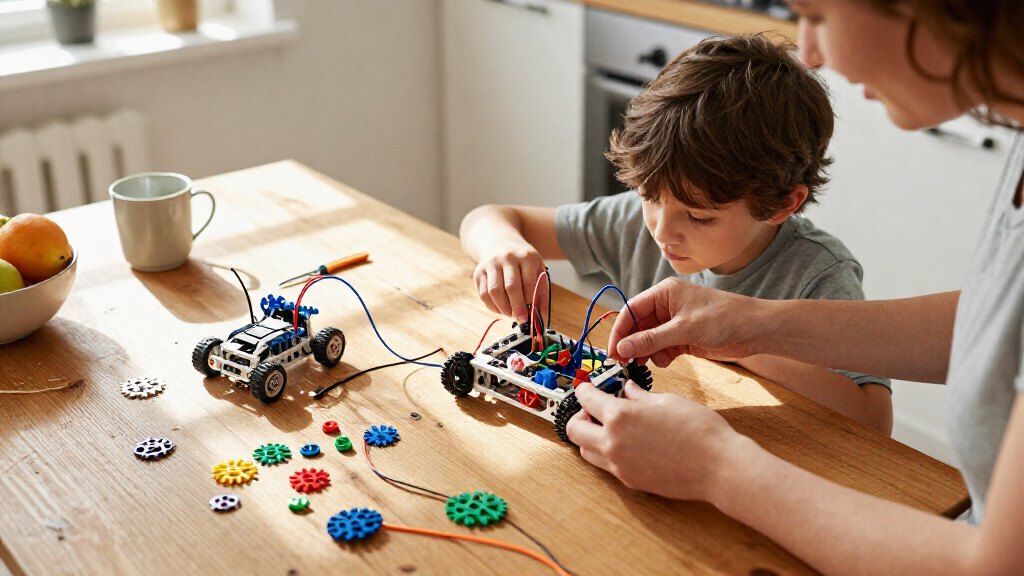
I compared these toys for the realities of ages 8–13: how clearly a child can get started, whether the activities connect building or play to STEM ideas, how much adult support may be needed, and whether the toy offers meaningful ways to keep experimenting. I also weighed practical fit, including small-part handling, assembly demands, dependence on sunlight, and whether the activity is suited to solo play or shared problem-solving. Since the lineup ranges from logic puzzles to powered builds, I judged each within its own play style rather than treating electronics as automatically more educational.
The ranking gives priority to a strong balance of accessibility, engaging hands-on learning, and repeat use across this broad age span. Snap Circuits Arcade earns the overall lead for making electronics interactive; Gravity Maze ranks as a strong alternative for children who prefer logic challenges over construction. More specialized kits rank well for their particular appeal but lower for narrower use, greater setup demands, or environmental limits. I treat listed project counts as a starting point, not proof of lasting value: the quality of the learning loop and the likelihood a child will return to it matter more.
Factors to Consider When Choosing Best STEM Toys For Ages 8-13
Before choosing, I’d match the toy to the child’s preferred way of solving problems, then check how much support and space the activity requires. These broader factors can prevent a kit from being too simple, too frustrating, or impractical for the household.
Match the Challenge to the Child, Not Just the Age Label
The 8–13 age span covers a wide range of reading, patience, and fine-motor skills, so an age label is only a rough guide. A younger child who enjoys puzzles may handle a demanding logic challenge better than a same-age child who dislikes step-by-step assembly. For older kids, a kit can still appeal if it invites redesign or explanation rather than stopping once the model is complete. Look for a clear first task and a next step that adds complexity. A common mistake is buying for the oldest age listed and assuming every child in the household will find it manageable. If siblings will share, favor activities with adjustable difficulty or distinct roles rather than one long build with a single bottleneck.
Choose a Learning Style That Holds Their Attention
STEM can mean testing a circuit, solving a spatial puzzle, building a mechanism, or programming a model; those activities do not feel interchangeable to a child. Start with what they already choose during free time, such as making things, figuring out riddles, or taking apart how objects work. A toy tied to a favorite kind of play is more likely to get used than one chosen only for its educational label. If the child enjoys quick wins, short challenges may be a better entry point than a multi-stage construction project. If they like tinkering, prioritize room to change a design and see what happens. Avoid assuming that a robot is automatically a better STEM fit than a puzzle or a mechanical launcher.
Check the Adult-Support and Frustration Level
Some kits ask children to follow detailed assembly steps, handle small components, or troubleshoot when a build does not work as expected. Decide whether the goal is independent play or a shared activity with a caregiver, because those call for different levels of challenge. A little support can make a difficult project rewarding, but frequent adult intervention may frustrate a child expecting to work alone. Before buying, review the project instructions and note whether they rely on written steps, diagrams, or prior knowledge. For a first STEM kit, a visible early success can help build confidence before harder tasks arrive. For a practiced builder, too much guidance can make the activity feel like following a recipe rather than experimenting.
Account for Space, Light, and Storage
Play conditions can matter as much as the activity itself. Solar-powered builds need suitable light, which may limit when and where a child can use them; a tabletop puzzle or circuit activity is less tied to weather and location. Mechanical builds may need room to assemble, test, and store a model without taking over a shared surface. Small pieces can be difficult to keep together, so think about whether the household has a tray, box, or dedicated workspace. These constraints are easy to overlook when focusing on the promise of a project. Choose a kit that fits the family’s actual routines rather than an ideal setup that rarely happens.
Look for Repeat Experimentation, Not Just a Big Project Count
A long list of projects can sound appealing, but the more useful question is whether the child can learn something by changing a design or testing a new idea. Rebuilding the same mechanism with a different goal can offer more lasting play than completing many similar instructions once. Check whether the toy provides challenges, adjustable parts, or room for child-led variations. Consider whether it can hold attention after the first successful build, especially if the child tends to move quickly from one activity to another. More elaborate kits may be worthwhile for a motivated tinkerer, while a focused puzzle can be a better fit for a child who prefers brief sessions. Pay for depth that suits the child, not a feature count they may never use.
Frequently Asked Questions
Which type of STEM toy is the easiest place to start for a child with no building experience?
I’d start with a toy that gives an immediate, understandable task instead of requiring a long build before anything works. A logic puzzle can introduce trial and error without small electronic connections, while a guided circuit kit offers a first taste of engineering through visible results. The better choice depends on whether the child prefers solving a challenge or assembling something. If they are easily discouraged, check that the instructions show each step clearly and that early activities are short. An approachable first project matters more than choosing the toy with the broadest subject coverage.
Are solar robot kits a good choice if a child mostly plays indoors?
They can be, but sunlight dependence may limit use if the available light is weak or inconsistent. Think about where the child will build and test the model, not only where it can be assembled. A solar kit is a stronger fit when there is a bright window, suitable outdoor space, or an interest in exploring how light powers a mechanism. If reliable play at any time is the priority, a tabletop circuit kit or logic game avoids that constraint. Checking the power source and operating conditions before purchase can prevent a build that is ready before the light is.
Should I choose an electronics kit or a logic puzzle for a mixed-age household?
Choose based on the kind of shared activity you want. A puzzle can let children take turns proposing solutions and may be easier to start and put away, while an electronics kit can create a longer collaborative build with more parts to manage. Mixed ages do not automatically mean a puzzle is the better option; older children may enjoy helping younger siblings test circuits if each can take an active role. Check whether the activities support different levels of participation instead of leaving one child to do all the work. For frequent independent play, favor the option each child can use without needing a partner.
How can I tell whether a STEM toy will stay interesting after the first build?
Look beyond the number of projects and ask what changes after the child learns the basic steps. Toys that invite testing, redesign, new challenges, or alternate solutions have a clearer path beyond a one-time assembly. A fixed model can still be worthwhile if the child enjoys completing a precise project, but it may have less appeal to a tinkerer who wants to modify things. Consider the child’s past habits: do they repeat favorite activities, or quickly seek a new challenge? Matching the toy’s replay style to those habits is a better signal than a project count alone.
Is it better to buy one advanced kit or several smaller STEM toys?
One advanced kit makes sense when a child already has a clear interest and enjoys sustained projects. Several smaller activities can offer more variety, but they may also split attention and create more loose parts to store. Before choosing, think about whether the child is more likely to return to one deep challenge or switch between different kinds of play. A focused puzzle can complement a construction kit if the child likes both independent thinking and making. If you are unsure about their interest, a manageable first activity can reveal more than a larger commitment built around an untested preference.
Conclusion
For the best overall fit, choose Snap Circuits Arcade SCA-200 if interactive electronics are likely to hold the child’s attention. For value, compare the Snap Circuits Explorer SC-100 if a broad set of circuit activities matters more than arcade-style play. For beginners, choose ThinkFun Gravity Maze for a clear, screen-free route into logical problem-solving; it is also a strong pick for kids who prefer puzzles to construction. For a premium, more involved project, consider CrunchLabs The Crunchinator for a child who enjoys mechanical building and can handle a longer challenge. For specific interests, choose a solar robot for light-powered builds, a Smartivity mechanical kit for hands-on mechanisms, or Kanoodle for compact solo brainteasers. My final choice would come down to the child’s preferred way to learn and the support, space, and play conditions available at home.